Physical background and theory
This page provides an overview of the physical background and numerical methods implemented in JURASSIC. The description focuses on the radiative transfer formulation, spectral approximations, and numerical integration schemes that enable fast and accurate infrared simulations. A detailed and formal description of the algorithms can be found in Baumeister and Hoffmann (2022).
Atmospheric representation
JURASSIC represents the atmosphere as a vertically stratified medium. Atmospheric state variables are defined on discrete altitude levels and include:
- pressure
- temperature
- volume mixing ratios of trace gases
- optional aerosol or cloud extinction coefficients
Between the specified levels, atmospheric quantities are interpolated linearly (pressure in logarithmic space). For geometric calculations, the Earth is approximated as a sphere with a fixed mean radius.
Ray tracing and refraction
Radiative transfer calculations are performed along curved ray paths that account for atmospheric refraction. Refraction causes bending of the ray paths toward the Earth’s surface and is particularly important for limb-sounding geometries.
Ray paths are calculated numerically by solving the Eikonal equation, which describes the propagation of electromagnetic waves in a medium with spatially varying refractive index. In the mid-infrared spectral range, JURASSIC uses a dry-air Edlen-type refractivity model. The implementation scales refractivity with pressure and temperature and evaluates the Edlen formula at a fixed reference wavelength of 10 micrometer. This provides a simple and stable approximation for thermal-infrared ray tracing while keeping the line-of-sight geometry independent of the active channel set.
However, this remains an approximation for infrared applications: the ray tracing does not use a fully spectrally resolved infrared refractivity model, and water-vapour effects on refractivity are neglected.
The ray tracing algorithm is generic and supports limb, nadir, zenith, and occultation geometries for instruments located inside or outside the atmosphere. The ray path is discretized into segments, which form the basis for the subsequent radiative transfer calculations.
Monochromatic radiative transfer equation
At the most fundamental level, radiative transfer in JURASSIC is based on the monochromatic radiative transfer equation along a ray path:
- absorption attenuates radiation along the path,
- thermal emission contributes according to the local temperature.
Under the assumption of local thermodynamic equilibrium (LTE) and in the absence of scattering, the source function reduces to the Planck function evaluated at the local temperature. This formulation is valid for most infrared applications in the troposphere and stratosphere.
A full monochromatic (line-by-line) evaluation of the radiative transfer equation would require explicit treatment of millions of spectral lines and is therefore computationally prohibitive for large-scale applications.
Band transmittance approximation
Satellite instruments measure radiances integrated over finite spectral bands rather than at individual wavenumbers. JURASSIC exploits this by using a band transmittance approximation, in which spectrally averaged quantities are used instead of monochromatic ones.
In this approach:
- the Planck function is averaged over the instrument spectral response,
- the atmospheric transmissivity is represented by band-averaged emissivities,
- radiative transfer is performed using these spectrally averaged quantities.
This approximation significantly reduces computational cost but introduces errors due to neglected spectral correlations. These errors are minimized through the use of advanced emissivity modelling techniques.
Emissivity lookup tables
Spectral absorption and emission are represented in JURASSIC using precomputed lookup tables of band-averaged emissivities. These tables are generated offline using detailed line-by-line radiative transfer models and spectroscopic databases.
Each lookup table provides spectral mean emissivity for the corresponding spectral channel and instrument response function as a function of:
- pressure
- temperature
- absorber column density
During runtime, emissivities are obtained through fast linear interpolation within the tables. This approach preserves much of the accuracy of line-by-line spectroscopy while enabling orders-of-magnitude faster calculations.
To keep lookup-table files within practical size limits, JURASSIC also provides adaptive, error-controlled table reduction. The reduction algorithm recursively removes absorber-column grid points that can be reconstructed by interpolation within configurable absolute and relative error thresholds, retaining higher grid density only where the emissivity curves require it.
The validity of the radiative transfer results depends on the coverage and resolution of the lookup tables.
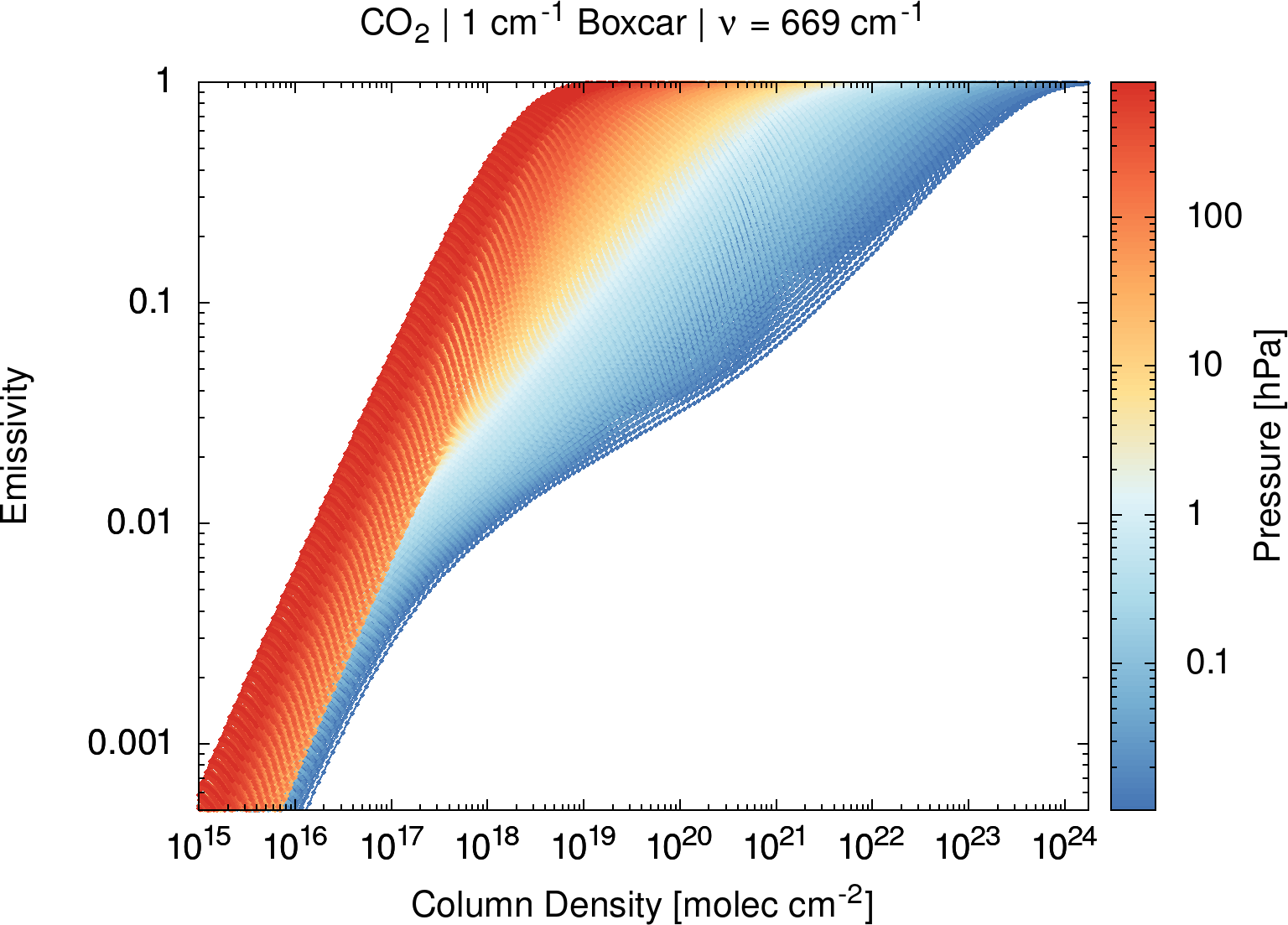
Spectral mean emissivity curves for carbon dioxide at 669 cm^-1, illustrating the lookup-table representation used by JURASSIC. Source: Baumeister and Hoffmann (2022), Fig. 2.
Emissivity Growth Approximation (EGA)
The Emissivity Growth Approximation (EGA) is a key component of JURASSIC and is used to compute the effective emissivity of an inhomogeneous atmospheric path. The method follows the EGA approach described by Gordley and Russell (1981).
Instead of treating each atmospheric segment independently, EGA accounts for the cumulative growth of emissivity along the ray path:
- The current total path emissivity is mapped to an equivalent “pseudo-column density” on the emissivity curve of the next segment.
- The emissivity increase due to the additional segment is then computed by advancing along this curve.
This procedure allows the model to approximate the emissivity of an inhomogeneous atmosphere using lookup tables derived for homogeneous layers. The EGA method substantially reduces errors associated with simple band transmittance approaches and has been shown to provide good accuracy for a wide range of infrared remote sensing applications.
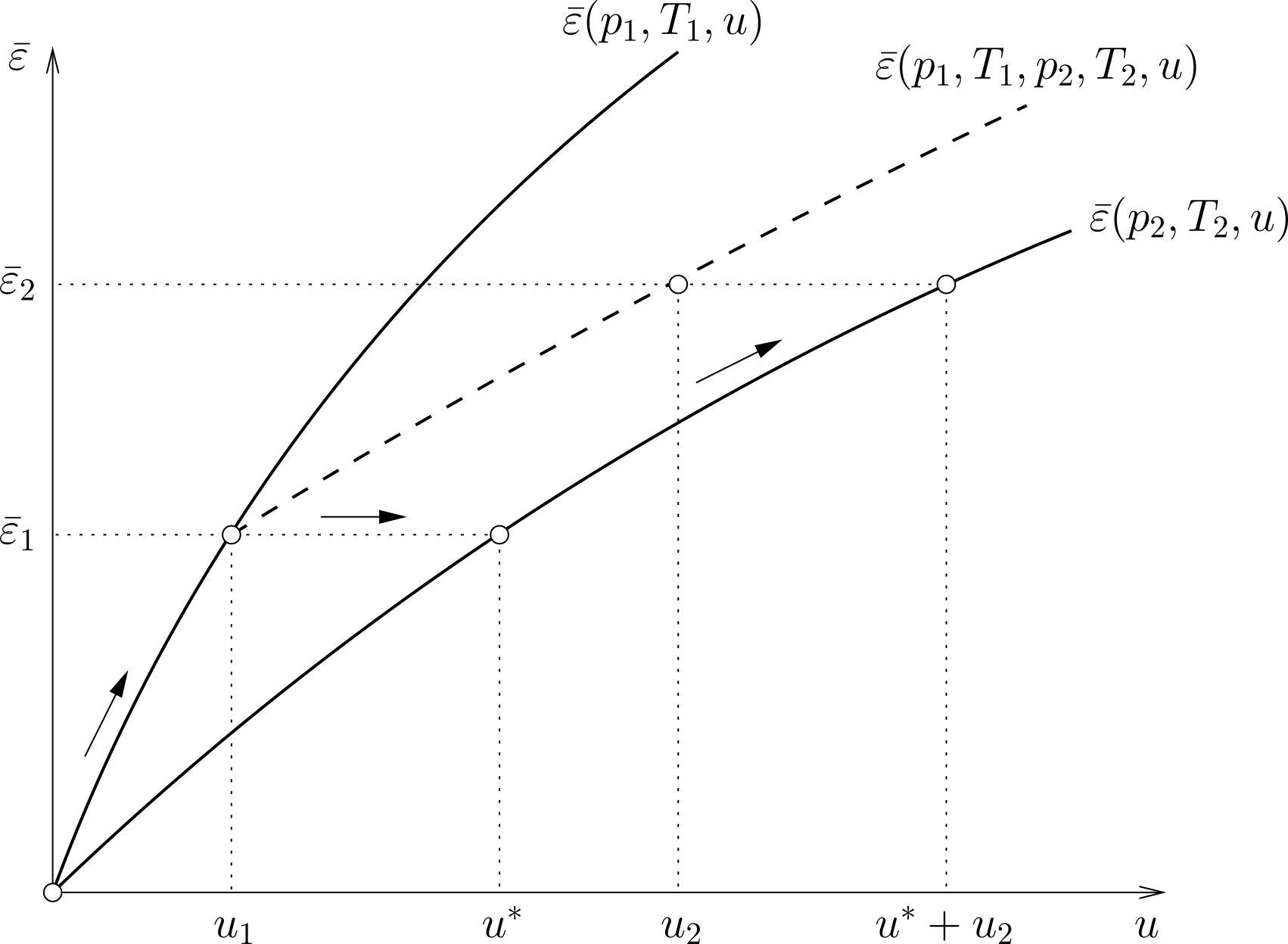
Illustration of the Emissivity Growth Approximation. The accumulated emissivity is mapped to a pseudo-column amount on the emissivity curve of the next path segment. Source: Baumeister and Hoffmann (2022), Fig. 3.
Numerical integration along the line of sight
Radiative transfer along the ray path is evaluated by dividing the path into discrete segments defined by the ray tracing algorithm. For each segment, atmospheric properties are assumed to be homogeneous.
The radiance at the instrument is obtained by iteratively accumulating the emission from each segment while accounting for absorption by the atmospheric path between that segment and the instrument. This procedure follows the Beer–Lambert law and ensures numerical stability and efficiency.
The integration scheme is designed to be compatible with both forward modelling and the calculation of derivatives required for retrieval applications.
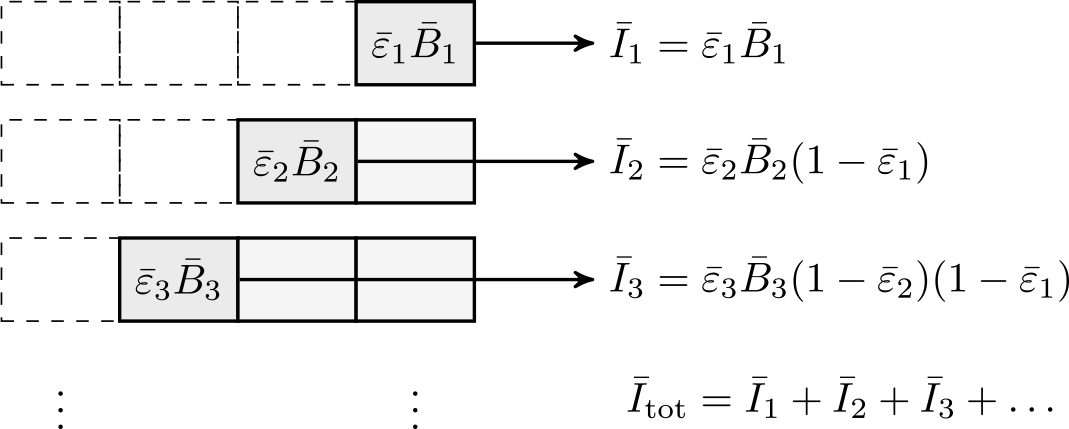
Radiance integration along a ray path. Emission contributions from individual path segments are partly absorbed along the atmospheric path between the segment and the observer. Source: Baumeister and Hoffmann (2022), Fig. 1.
Multiple absorbers and continua
JURASSIC supports multiple molecular absorbers and includes continuum absorption and emission processes for selected gases. The total emissivity is constructed from the individual gas contributions under a continuum approximation, which neglects higher-order spectral correlation terms between different species.
This approximation is accurate for many broadband and moderate-resolution applications but represents a known limitation for very narrow spectral channels or strongly overlapping absorption features.
Relation to retrieval calculations
The radiative transfer formulation described above forms the basis for both forward simulations and inverse modelling in JURASSIC. Retrievals use the same forward model to compute simulated radiances, while sensitivities with respect to atmospheric state variables are evaluated by finite differencing rather than by analytic Jacobians.
Using the same forward-model implementation for the unperturbed and perturbed calculations keeps the Jacobians consistent with the radiance calculation used in optimal estimation retrievals.
Summary
JURASSIC combines physically sound radiative transfer theory with carefully chosen approximations to achieve high computational performance. By using curved ray tracing, emissivity lookup tables, and the emissivity growth approximation, the model enables fast and accurate infrared simulations suitable for large-scale atmospheric remote sensing and retrieval applications.
For a comprehensive and formal derivation of the algorithms, users are referred to Baumeister and Hoffmann (2022) and the references listed in the References section.