 |
JURASSIC
|
|
JURASSIC
|
JURASSIC library definitions. More...
#include "jurassic.h"Go to the source code of this file.
Functions | |
| void | analyze_avk (const ret_t *ret, const ctl_t *ctl, const atm_t *atm, const int *iqa, const int *ipa, const gsl_matrix *avk) |
| Analyze averaging kernel (AVK) matrix for retrieval diagnostics. More... | |
| void | analyze_avk_quantity (const gsl_matrix *avk, const int iq, const int *ipa, const size_t *n0, const size_t *n1, double *cont, double *res) |
| Analyze averaging kernel submatrix for a specific retrieved quantity. More... | |
| size_t | atm2x (const ctl_t *ctl, const atm_t *atm, gsl_vector *x, int *iqa, int *ipa) |
| Convert atmospheric data to state vector elements. More... | |
| void | atm2x_help (const double value, const int value_iqa, const int value_ip, gsl_vector *x, int *iqa, int *ipa, size_t *n) |
| Append a single atmospheric value to the state vector. More... | |
| void | cart2geo (const double *x, double *z, double *lon, double *lat) |
| Converts Cartesian coordinates to geographic coordinates. More... | |
| void | climatology (const ctl_t *ctl, atm_t *atm) |
| Initializes atmospheric climatology profiles. More... | |
| double | cos_sza (const double sec, const double lon, const double lat) |
| Calculates the cosine of the solar zenith angle. More... | |
| double | cost_function (const gsl_vector *dx, const gsl_vector *dy, const gsl_matrix *s_a_inv, const gsl_vector *sig_eps_inv) |
| Compute the normalized quadratic cost function for optimal estimation. More... | |
| double | ctmco2 (const double nu, const double p, const double t, const double u) |
| Compute carbon dioxide continuum optical depth. More... | |
| double | ctmh2o (const double nu, const double p, const double t, const double q, const double u) |
| Compute the MT_CKD 4.1 water vapor continuum (optical depth). More... | |
| double | ctmn2 (const double nu, const double p, const double t) |
| Compute N₂ collision-induced absorption coefficient. More... | |
| double | ctmo2 (const double nu, const double p, const double t) |
| Compute O₂ collision-induced absorption coefficient. More... | |
| void | copy_atm (const ctl_t *ctl, atm_t *atm_dest, const atm_t *atm_src, const int init) |
| Copy or initialize atmospheric profile data. More... | |
| void | copy_obs (const ctl_t *ctl, obs_t *obs_dest, const obs_t *obs_src, const int init) |
| Copy or initialize observation geometry and radiance data. More... | |
| void | day2doy (int year, int mon, int day, int *doy) |
| Convert a calendar date to day-of-year. More... | |
| void | doy2day (int year, int doy, int *mon, int *day) |
| Convert a day-of-year value to a calendar date. More... | |
| int | find_emitter (const ctl_t *ctl, const char *emitter) |
| Find gas species index by name. More... | |
| int | formod (const ctl_t *ctl, const tbl_t *tbl, atm_t *atm, obs_t *obs, los_t *los_scratch, obs_t *obs_scratch) |
| Execute one complete forward-model calculation. More... | |
| void | formod_batch (const ctl_t *ctl, const tbl_t *tbl, atm_t *atm, obs_t *obs, const int nbatch, int *status, los_t *los_scratch, obs_t *obs_scratch) |
| Execute the forward model for a batch of independent cases. More... | |
| void | formod_continua (const ctl_t *ctl, const los_t *los, const int ip, double *beta) |
| Compute total extinction including gaseous continua. More... | |
| int | formod_fov (const ctl_t *ctl, obs_t *obs, obs_t *obs_scratch) |
| Apply field-of-view (FOV) convolution to modeled radiances. More... | |
| int | formod_pencil (const ctl_t *ctl, const tbl_t *tbl, const atm_t *atm, obs_t *obs, const int ir, los_t *los) |
| Compute line-of-sight radiances using the pencil-beam forward model. More... | |
| void | formod_rfm (const ctl_t *ctl, const tbl_t *tbl, const atm_t *atm, obs_t *obs) |
| Forward-model radiance and transmittance with the Reference Forward Model (RFM). More... | |
| void | formod_srcfunc (const ctl_t *ctl, const tbl_t *tbl, const double t, double *src) |
| Interpolate the source function (Planck radiance) at a given temperature. More... | |
| void | geo2cart (const double z, const double lon, const double lat, double *x) |
| Converts geographic coordinates (longitude, latitude, altitude) to Cartesian coordinates. More... | |
| void | hydrostatic (const ctl_t *ctl, atm_t *atm) |
| Adjust pressure profile using the hydrostatic equation. More... | |
| void | idx2name (const ctl_t *ctl, const int idx, char *quantity) |
| Convert a quantity index to a descriptive name string. More... | |
| void | init_srcfunc (const ctl_t *ctl, tbl_t *tbl) |
| Initialize source function lookup tables from emissivity data. More... | |
| void | intpol_atm (const ctl_t *ctl, const atm_t *atm, const double z, double *p, double *t, double *q, double *k) |
| Interpolate atmospheric state variables at a given altitude. More... | |
| void | intpol_tbl_cga (const ctl_t *ctl, const tbl_t *tbl, const los_t *los, const int ip, double tau_path[ND][NG], double tau_seg[ND]) |
| Interpolate emissivities and transmittances using the Curtis–Godson approximation (CGA). More... | |
| void | intpol_tbl_ega (const ctl_t *ctl, const tbl_t *tbl, const los_t *los, const int ip, double tau_path[ND][NG], double tau_seg[ND]) |
| Interpolate emissivities and transmittances using the Emissivity Growth Approximation (EGA). More... | |
| double | intpol_tbl_eps (const tbl_t *tbl, const int ig, const int id, const int ip, const int it, const double logu) |
| Interpolate gas emissivity as a function of column amount. More... | |
| double | intpol_tbl_u (const tbl_t *tbl, const int ig, const int id, const int ip, const int it, const double logeps) |
| Interpolate column amount as a function of emissivity. More... | |
| void | jsec2time (const double jsec, int *year, int *mon, int *day, int *hour, int *min, int *sec, double *remain) |
| Converts Julian seconds to calendar date and time components. More... | |
| void | kernel (const ctl_t *ctl, const tbl_t *tbl, atm_t *atm, obs_t *obs, gsl_matrix *k) |
| Compute the Jacobian (kernel) matrix by finite differences. More... | |
| int | locate_irr (const double *xx, const int n, const double x) |
| Locate index for interpolation on an irregular grid. More... | |
| int | locate_reg (const double *xx, const int n, const double x) |
| Locate index for interpolation on a regular (uniform) grid. More... | |
| int | locate_tbl (const float *xx, const int n, const double x) |
| Locate index for interpolation within emissivity table grids. More... | |
| void | matrix_invert (gsl_matrix *a) |
| Invert a square matrix, optimized for diagonal or symmetric positive-definite matrices. More... | |
| void | matrix_product (const gsl_matrix *a, const gsl_vector *b, const int transpose, gsl_matrix *c) |
| Compute structured matrix products of the form \(A^T B A\) or \(A B A^T\). More... | |
| size_t | obs2y (const ctl_t *ctl, const obs_t *obs, gsl_vector *y, int *ida, int *ira) |
| Convert observation radiances into a measurement vector. More... | |
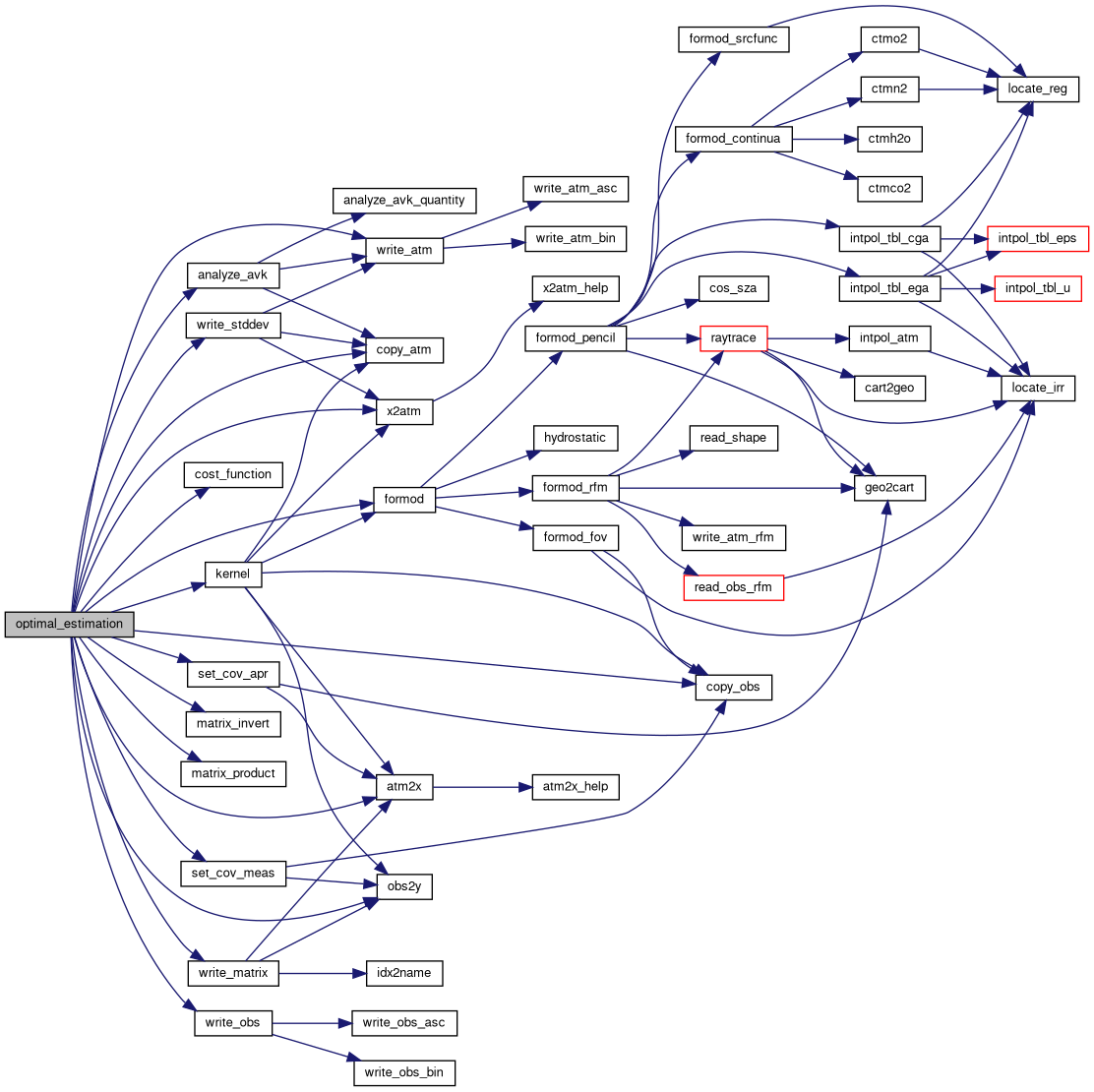
| void | optimal_estimation (ret_t *ret, ctl_t *ctl, tbl_t *tbl, obs_t *obs_meas, obs_t *obs_i, atm_t *atm_apr, atm_t *atm_i, double *chisq) |
| Perform optimal estimation retrieval using Levenberg–Marquardt minimization. More... | |
| int | raytrace (const ctl_t *ctl, const atm_t *atm, obs_t *obs, los_t *los, const int ir) |
| Perform line-of-sight (LOS) ray tracing through the atmosphere. More... | |
| void | read_atm (const char *dirname, const char *filename, const ctl_t *ctl, atm_t *atm, int profile) |
| Read atmospheric input data from a file. More... | |
| void | read_atm_asc (const char *filename, const ctl_t *ctl, atm_t *atm) |
| Read atmospheric data in ASCII format. More... | |
| void | read_atm_bin (const char *filename, const ctl_t *ctl, atm_t *atm) |
| Read atmospheric data in binary format. More... | |
| void | read_atm_nc (const char *filename, const ctl_t *ctl, atm_t *atm, int profile) |
| Read one atmospheric profile from a netCDF file. More... | |
| void | read_ctl (int argc, char *argv[], ctl_t *ctl) |
| Read model control parameters from command-line and configuration input. More... | |
| void | read_matrix (const char *dirname, const char *filename, const ctl_t *ctl, gsl_matrix *matrix, int dataset) |
| Read a numerical matrix from a file. More... | |
| void | read_matrix_asc (const char *dirname, const char *filename, gsl_matrix *matrix) |
| Read a numerical matrix from an ASCII file. More... | |
| void | read_matrix_bin (const char *dirname, const char *filename, gsl_matrix *matrix) |
| Read a numerical matrix from a binary file. More... | |
| void | read_matrix_nc (const char *dirname, const char *filename, gsl_matrix *matrix, int dataset) |
| Read a numerical matrix from a netCDF file. More... | |
| void | read_obs (const char *dirname, const char *filename, const ctl_t *ctl, obs_t *obs, int profile) |
| Read observation data from an input file. More... | |
| void | read_obs_asc (const char *filename, const ctl_t *ctl, obs_t *obs) |
| Read ASCII-formatted observation data from a file. More... | |
| void | read_obs_bin (const char *filename, const ctl_t *ctl, obs_t *obs) |
| Read binary-formatted observation data from a file. More... | |
| void | read_obs_nc (const char *filename, const ctl_t *ctl, obs_t *obs, const int profile) |
| Read one observation profile from a NetCDF file. More... | |
| double | read_obs_rfm (const char *basename, const double z, const double *nu, const double *f, const int n) |
| Read and spectrally convolve an RFM output spectrum. More... | |
| void | read_ret (int argc, char *argv[], const ctl_t *ctl, ret_t *ret) |
| Read retrieval configuration and error parameters. More... | |
| void | read_rfm_spec (const char *filename, double *nu, double *rad, int *npts) |
| Read a Reference Forward Model (RFM) ASCII spectrum. More... | |
| void | read_shape (const char *filename, double *x, double *y, int *n) |
| Read a two-column shape function from an ASCII file. More... | |
| tbl_t * | read_tbl (const ctl_t *ctl) |
| Read emissivity lookup tables from disk. More... | |
| void | read_tbl_asc (const ctl_t *ctl, tbl_t *tbl, const int id, const int ig) |
| Read a single ASCII emissivity lookup table. More... | |
| void | read_tbl_bin (const ctl_t *ctl, tbl_t *tbl, const int id, const int ig) |
| Read a single compact binary emissivity lookup table. More... | |
| void | read_tbl_nc_channel (const ctl_t *ctl, tbl_t *tbl, int id, int ig, int ncid) |
| Read one packed emissivity lookup table from an open NetCDF file. More... | |
| double | scan_ctl (int argc, char *argv[], const char *varname, const int arridx, const char *defvalue, char *value) |
| Scan control file or command-line arguments for a configuration variable. More... | |
| void | set_cov_apr (const ret_t *ret, const ctl_t *ctl, const atm_t *atm, const int *iqa, const int *ipa, gsl_matrix *s_a) |
| Construct the a priori covariance matrix \(\mathbf{S_a}\) for retrieval parameters. More... | |
| void | set_cov_meas (const ret_t *ret, const ctl_t *ctl, const obs_t *obs, gsl_vector *sig_noise, gsl_vector *sig_formod, gsl_vector *sig_eps_inv) |
| Construct measurement error standard deviations and their inverse. More... | |
| const char * | shared_io_input_target (const ret_t *ret, const char *shared_file, const char *legacy_file, const char **dirname, int *profile) |
| Resolve retrieval input target for legacy-directory and shared-file modes. More... | |
| const char * | shared_io_output_target (const ret_t *ret, const char *shared_file, const char *legacy_file, const char **dirname, int *profile) |
| Resolve retrieval output target for legacy-directory and shared-file modes. More... | |
| int | shared_io_lock (const ret_t *ret) |
| Acquire an exclusive lock for shared retrieval output files. More... | |
| void | shared_io_unlock (int fd) |
| Release a shared retrieval output lock. More... | |
| const char * | shared_io_output_file (const ret_t *ret) |
| Return the primary shared retrieval output file configured for locking. More... | |
| void | tangent_point (const los_t *los, double *tpz, double *tplon, double *tplat) |
| Determine the tangent point along a line of sight (LOS). More... | |
| void | tbl_free (const ctl_t *ctl, tbl_t *tbl) |
| Free lookup table and all internally allocated memory. More... | |
| void | tbl_pack (const tbl_t *tbl, int id, int ig, uint8_t *buf, size_t *bytes_used) |
| Pack a lookup table into a contiguous binary buffer. More... | |
| size_t | tbl_packed_size (const tbl_t *tbl, int id, int ig) |
| Compute required buffer size (in bytes) for tbl_pack(). More... | |
| size_t | tbl_unpack (tbl_t *tbl, int id, int ig, const uint8_t *buf) |
| Unpack a lookup table from a contiguous binary buffer. More... | |
| void | time2jsec (const int year, const int mon, const int day, const int hour, const int min, const int sec, const double remain, double *jsec) |
| Converts time components to seconds since January 1, 2000, 12:00:00 UTC. More... | |
| void | timer_group (const char *name, const char *group, int output) |
| Aggregate wall-clock timings for named code phases. More... | |
| void | write_atm (const char *dirname, const char *filename, const ctl_t *ctl, const atm_t *atm, int profile) |
| Write atmospheric data to a file. More... | |
| void | write_atm_asc (const char *filename, const ctl_t *ctl, const atm_t *atm) |
| Write atmospheric data to an ASCII file. More... | |
| void | write_atm_bin (const char *filename, const ctl_t *ctl, const atm_t *atm) |
| Write atmospheric data to a binary file. More... | |
| void | write_atm_nc (const char *filename, const ctl_t *ctl, const atm_t *atm, int profile) |
| Write one atmospheric profile to a netCDF file. More... | |
| void | write_atm_rfm (const char *filename, const ctl_t *ctl, const atm_t *atm) |
| Write atmospheric profile in RFM-compatible format. More... | |
| void | write_matrix (const char *dirname, const char *filename, const ctl_t *ctl, const gsl_matrix *matrix, const atm_t *atm, const obs_t *obs, const char *rowspace, const char *colspace, const char *sort, int dataset) |
| Write a fully annotated matrix (e.g., Jacobian or gain matrix) to file. More... | |
| void | write_matrix_asc (const char *dirname, const char *filename, const ctl_t *ctl, const gsl_matrix *matrix, const atm_t *atm, const obs_t *obs, const char *rowspace, const char *colspace, const char *sort) |
| Write a fully annotated matrix (e.g., Jacobian or gain matrix) to an ASCII file. More... | |
| void | write_matrix_bin (const char *dirname, const char *filename, const gsl_matrix *matrix) |
| Write a numerical matrix to a binary file. More... | |
| void | write_matrix_nc (const char *dirname, const char *filename, const ctl_t *ctl, const gsl_matrix *matrix, const atm_t *atm, const obs_t *obs, const char *rowspace, const char *colspace, const char *sort, int dataset) |
| Write a numerical matrix to a netCDF file. More... | |
| void | write_obs (const char *dirname, const char *filename, const ctl_t *ctl, const obs_t *obs, int profile) |
| Write observation data to an output file in ASCII or binary format. More... | |
| void | write_obs_asc (const char *filename, const ctl_t *ctl, const obs_t *obs) |
| Write observation data to an ASCII text file. More... | |
| void | write_obs_bin (const char *filename, const ctl_t *ctl, const obs_t *obs) |
| Write observation data in binary format to a file. More... | |
| void | write_obs_nc (const char *filename, const ctl_t *ctl, const obs_t *obs, const int profile) |
| Write one observation profile to a NetCDF file. More... | |
| void | write_shape (const char *filename, const double *x, const double *y, const int n) |
| Write tabulated shape function data to a text file. More... | |
| void | write_stddev (const char *quantity, const ret_t *ret, const ctl_t *ctl, const atm_t *atm, const gsl_matrix *s) |
| Write retrieval standard deviation profiles to disk. More... | |
| void | write_tbl (const ctl_t *ctl, const tbl_t *tbl) |
| Write emissivity lookup tables to disk. More... | |
| void | write_tbl_asc (const ctl_t *ctl, const tbl_t *tbl, const int id, const int ig) |
| Write one emissivity lookup table in human-readable ASCII format. More... | |
| void | write_tbl_bin (const ctl_t *ctl, const tbl_t *tbl, const int id, const int ig) |
| Write one emissivity lookup table in compact binary format. More... | |
| void | write_tbl_nc (const ctl_t *ctl, const tbl_t *tbl, const int id, const int ig) |
| Write one packed lookup table to a NetCDF file. More... | |
| void | x2atm (const ctl_t *ctl, const gsl_vector *x, atm_t *atm) |
| Map retrieval state vector back to atmospheric structure. More... | |
| void | x2atm_help (double *value, const gsl_vector *x, size_t *n) |
| Helper function to extract a single value from the retrieval state vector. More... | |
| void | y2obs (const ctl_t *ctl, const gsl_vector *y, obs_t *obs) |
Copy elements from the measurement vector y into the observation structure. More... | |
JURASSIC library definitions.
Definition in file jurassic.c.
| void analyze_avk | ( | const ret_t * | ret, |
| const ctl_t * | ctl, | ||
| const atm_t * | atm, | ||
| const int * | iqa, | ||
| const int * | ipa, | ||
| const gsl_matrix * | avk | ||
| ) |
Analyze averaging kernel (AVK) matrix for retrieval diagnostics.
Decomposes and evaluates the averaging kernel matrix \(\mathbf{A}\) to quantify the retrieval sensitivity and vertical resolution for each retrieved quantity (pressure, temperature, trace gases, extinction, etc.). The results are written to diagnostic atmospheric files for visualization.
| [in] | ret | Retrieval control and configuration structure (ret_t). |
| [in] | ctl | Global control structure (ctl_t) defining retrieval setup and quantities. |
| [in] | atm | Retrieved atmospheric state structure (atm_t). |
| [in] | iqa | Array mapping state vector indices to physical quantities (e.g., IDXP, IDXT, IDXQ(...)). |
| [in] | ipa | Array mapping state vector indices to atmospheric grid points. |
| [in] | avk | Averaging kernel matrix \(\mathbf{A}\) (gsl_matrix, n×n). |
The averaging kernel matrix \(\mathbf{A}\) describes the sensitivity of the retrieved state \(\hat{x}\) to the true state \(x\):
\[ \hat{x} - x_a = \mathbf{A} (x - x_a) \]
where \(x_a\) is the a priori state.
This function separates and evaluates:
Internally, this function:
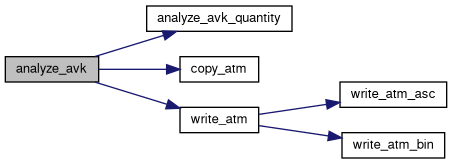
analyze_avk_quantity() for each retrieved parameter type to compute quantitative measures of contribution and resolution.atm_cont.tab — contribution functions (sensitivity).atm_res.tab — resolution functions (vertical response width).iqa[i] to the quantity constants (e.g., IDXT, IDXQ(ig), etc.).ret->dir).ret->dir.Definition at line 29 of file jurassic.c.
| void analyze_avk_quantity | ( | const gsl_matrix * | avk, |
| const int | iq, | ||
| const int * | ipa, | ||
| const size_t * | n0, | ||
| const size_t * | n1, | ||
| double * | cont, | ||
| double * | res | ||
| ) |
Analyze averaging kernel submatrix for a specific retrieved quantity.
Computes the contribution (sensitivity) and resolution (information density) profiles for a given physical quantity from its corresponding submatrix of the full averaging kernel matrix \(\mathbf{A}\).
| [in] | avk | Averaging kernel matrix \(\mathbf{A}\) (gsl_matrix, n×n), describing the sensitivity of the retrieved state to the true state. |
| [in] | iq | Quantity index identifier (e.g., IDXP, IDXT, IDXQ(ig), IDXK(iw), IDXCLZ, etc.). |
| [in] | ipa | Array mapping state vector indices to atmospheric grid indices. |
| [in] | n0 | Array of starting indices for each quantity sub-block in the state vector. |
| [in] | n1 | Array of lengths (number of elements) for each quantity sub-block. |
| [out] | cont | Array of contribution values, representing the total sensitivity or response of the retrieval at each grid point. |
| [out] | res | Array of resolution measures, representing the vertical information density or averaging kernel width at each grid point. |
For a given quantity \(q\), the function extracts its corresponding block \(\mathbf{A}_q\) from the full averaging kernel matrix and computes:
\[ \text{cont}_i = \sum_j A_{ij}^{(q)} \]
giving the total response of retrieved element \(i\) to perturbations in all true elements \(j\) of the same quantity.\[ \text{res}_i = \frac{1}{A_{ii}^{(q)}} \]
approximating the degree of vertical resolution or smoothing at level \(i\).The results are stored in the provided arrays cont[] and res[], indexed according to the atmospheric profile index via ipa[].
iq) are processed.atm->np).A_ii is zero or near-zero, the corresponding resolution value may be undefined or numerically unstable.n0[iq] and n1[iq] must have been computed by analyze_avk().Definition at line 101 of file jurassic.c.
Convert atmospheric data to state vector elements.
Extracts selected quantities from an atmospheric profile (atm_t) according to retrieval settings in ctl_t, and appends them to the state vector x. For each included quantity, the function also stores its quantity index (iqa) and profile index (ipa).
The function respects retrieval altitude limits defined in ctl (e.g., retp_zmin/zmax, rett_zmin/zmax, etc.) and includes only variables flagged for retrieval (e.g., ret_clz, ret_sft, etc.).
| [in] | ctl | Control settings defining retrieval configuration and limits. |
| [in] | atm | Atmospheric profile data to extract from. |
| [out] | x | GSL vector to store state-vector elements. |
| [out] | iqa | Quantity index array corresponding to elements in x. |
| [out] | ipa | Profile index array corresponding to elements in x. |
Definition at line 125 of file jurassic.c.

| void atm2x_help | ( | const double | value, |
| const int | value_iqa, | ||
| const int | value_ip, | ||
| gsl_vector * | x, | ||
| int * | iqa, | ||
| int * | ipa, | ||
| size_t * | n | ||
| ) |
Append a single atmospheric value to the state vector.
Helper routine for atm2x(). Inserts one scalar value and its corresponding quantity and profile indices into the state vector and tracking arrays, then increments the element counter.
| [in] | value | Value to add to the state vector. |
| [in] | value_iqa | Quantity index (e.g., IDXP, IDXT, etc.). |
| [in] | value_ip | Profile index within the atmospheric profile. |
| [out] | x | GSL vector containing state-vector elements (may be NULL). |
| [out] | iqa | Quantity index array corresponding to x (may be NULL). |
| [out] | ipa | Profile index array corresponding to x (may be NULL). |
| [in,out] | n | Current number of elements in the state vector; incremented on return. |
Definition at line 179 of file jurassic.c.
| void cart2geo | ( | const double * | x, |
| double * | z, | ||
| double * | lon, | ||
| double * | lat | ||
| ) |
Converts Cartesian coordinates to geographic coordinates.
This function converts a point from Cartesian coordinates (x, y, z) to geographic coordinates (longitude, latitude, and altitude). It uses the spherical Earth approximation for the conversion.
| x | Pointer to an array containing the Cartesian coordinates (x, y, z) in kilometers. |
| z | Pointer to a double where the computed altitude (above the reference ellipsoid) will be stored, in kilometers. |
| lon | Pointer to a double where the computed longitude (in degrees) will be stored. |
| lat | Pointer to a double where the computed latitude (in degrees) will be stored. |
Definition at line 200 of file jurassic.c.
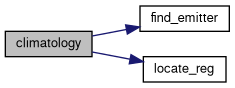
Initializes atmospheric climatology profiles.
This function populates the atmospheric state (atm) with standard climatological profiles of pressure, temperature, and trace gas concentrations (e.g., H2O, CH4, CO, O3, etc.) as a function of altitude. The profiles are based on reference climatological datasets and are used for atmospheric modeling and radiative transfer calculations.
| [in] | ctl | Control parameters structure. |
| [out] | atm | Atmospheric state structure to be populated with climatological data. |
Definition at line 215 of file jurassic.c.
| double cos_sza | ( | const double | sec, |
| const double | lon, | ||
| const double | lat | ||
| ) |
Calculates the cosine of the solar zenith angle.
This function computes the cosine of the solar zenith angle (SZA), which describes the angle between the local zenith (straight up) and the line connecting the observer to the center of the Sun. The cosine of the SZA is often used directly in radiative transfer and photochemical calculations to avoid unnecessary use of trigonometric inverse functions.
| sec | Seconds elapsed since 2000-01-01T12:00Z. |
| lon | Observer's longitude in degrees. |
| lat | Observer's latitude in degrees. |
The cosine of the solar zenith angle is computed based on the observer's position (longitude and latitude) and the specified time in seconds elapsed since 2000-01-01T12:00Z.
Definition at line 1152 of file jurassic.c.
| double cost_function | ( | const gsl_vector * | dx, |
| const gsl_vector * | dy, | ||
| const gsl_matrix * | s_a_inv, | ||
| const gsl_vector * | sig_eps_inv | ||
| ) |
Compute the normalized quadratic cost function for optimal estimation.
Evaluates the cost function
\[ J = \frac{1}{m} \left[ (\mathbf{y} - \mathbf{y_a})^T \mathbf{S_\epsilon^{-1}} (\mathbf{y} - \mathbf{y_a}) + (\mathbf{x} - \mathbf{x_a})^T \mathbf{S_a^{-1}} (\mathbf{x} - \mathbf{x_a}) \right] \]
where \(\mathbf{dx} = \mathbf{x} - \mathbf{x_a}\) and \(\mathbf{dy} = \mathbf{y} - \mathbf{y_a}\) represent the deviations from a priori state and measurement vectors, respectively.
| [in] | dx | State deviation vector (x - x_a). |
| [in] | dy | Measurement deviation vector (y - y_a). |
| [in] | s_a_inv | Inverse of the a priori covariance matrix ( \(\mathbf{S_a^{-1}}\)). |
| [in] | sig_eps_inv | Vector of inverse measurement uncertainties ( \(\mathbf{S_\epsilon^{-1/2}}\) diagonal elements). |
Definition at line 1193 of file jurassic.c.
| double ctmco2 | ( | const double | nu, |
| const double | p, | ||
| const double | t, | ||
| const double | u | ||
| ) |
Compute carbon dioxide continuum optical depth.
Uses the RFM CO2 continuum coefficients tabulated from 0 to 4000 cm^-1 at 230, 260, and 296 K. The coefficients represent residual CO2 line-wing absorption outside the +/-25 cm^-1 line-calculation interval.
| [in] | nu | Wavenumber [cm^-1]. |
| [in] | p | Pressure [hPa]. |
| [in] | t | Temperature [K]. |
| [in] | u | CO2 column density [molecules cm^-2]. |
Clough et al., Current Issues in Atmospheric Transparency, CUEN (1987).
Definition at line 1224 of file jurassic.c.
| double ctmh2o | ( | const double | nu, |
| const double | p, | ||
| const double | t, | ||
| const double | q, | ||
| const double | u | ||
| ) |
Compute the MT_CKD 4.1 water vapor continuum (optical depth).
Definition at line 2087 of file jurassic.c.
| double ctmn2 | ( | const double | nu, |
| const double | p, | ||
| const double | t | ||
| ) |
Compute N₂ collision-induced absorption coefficient.
Calculates the nitrogen (N₂) absorption coefficient due to collision-induced absorption (CIA) near the 4.3 µm CO₂ band using tabulated laboratory data for the absorption strength (B) and temperature exponent (β).
The function linearly interpolates B and β as a function of wavenumber, then applies a temperature- and pressure-dependent scaling relation to compute the absorption coefficient.
| [in] | nu | Wavenumber [cm⁻¹]. |
| [in] | p | Pressure [hPa]. |
| [in] | t | Temperature [K]. |
Definition at line 2983 of file jurassic.c.

| double ctmo2 | ( | const double | nu, |
| const double | p, | ||
| const double | t | ||
| ) |
Compute O₂ collision-induced absorption coefficient.
Calculates the molecular oxygen (O₂) absorption coefficient due to collision-induced absorption (CIA) using tabulated laboratory data for the absorption strength (B) and temperature exponent (β).
The function linearly interpolates B and β as a function of wavenumber and applies a pressure- and temperature-dependent scaling relation to compute the absorption coefficient.
| [in] | nu | Wavenumber [cm⁻¹]. |
| [in] | p | Pressure [hPa]. |
| [in] | t | Temperature [K]. |
Definition at line 3052 of file jurassic.c.

Copy or initialize atmospheric profile data.
Copies all fields from one atmospheric structure (atm_src) to another (atm_dest), including geolocation, thermodynamic, gas, extinction, cloud, and surface parameters. If init is nonzero, the destination fields are instead initialized to default values (zeros for most fields, unity for surface emissivity).
| [in] | ctl | Control structure defining array dimensions. |
| [out] | atm_dest | Destination atmospheric structure. |
| [in] | atm_src | Source atmospheric structure. |
| [in] | init | Initialization flag:
|
atm_src->np) determines the amount of data copied. The function performs shallow copies using memcpy for efficiency.Definition at line 3114 of file jurassic.c.
Copy or initialize observation geometry and radiance data.
Copies all observation fields from a source structure (obs_src) to a destination structure (obs_dest), including observer, view, and tangent point geometry, as well as radiance and transmittance data. If init is nonzero, radiance and transmittance values are reset to zero wherever finite values are found.
| [in] | ctl | Control structure defining the number of channels (ctl_t::nd) and other dimensions. |
| [out] | obs_dest | Destination observation structure. |
| [in] | obs_src | Source observation structure. |
| [in] | init | Initialization flag:
|
obs_src->nr) defines the copied data size. Shallow copies are performed via memcpy for efficiency.Definition at line 3164 of file jurassic.c.
| void day2doy | ( | int | year, |
| int | mon, | ||
| int | day, | ||
| int * | doy | ||
| ) |
Convert a calendar date to day-of-year.
This function computes the day-of-year (1–365 or 1–366 for leap years) corresponding to a given Gregorian date specified by year, month, and day.
Leap years are determined using the standard Gregorian rules:
| year | The full year (e.g., 2025). | |
| mon | The month of the year (1–12). | |
| day | The day of the month (1–31). | |
| [out] | doy | Pointer to an integer where the resulting day-of-year will be stored (1–365 or 1–366). |
Definition at line 3202 of file jurassic.c.
| void doy2day | ( | int | year, |
| int | doy, | ||
| int * | mon, | ||
| int * | day | ||
| ) |
Convert a day-of-year value to a calendar date.
This function computes the month and day corresponding to a given day-of-year (1–365 or 1–366 for leap years) in the Gregorian calendar.
Leap years are determined using the standard Gregorian rules:
| year | The full year (e.g., 2025). | |
| doy | The day-of-year (1–365 or 1–366). | |
| [out] | mon | Pointer to an integer where the calculated month (1–12) will be stored. |
| [out] | day | Pointer to an integer where the calculated day-of-month will be stored. |
doy is within the valid range for the specified year.Definition at line 3222 of file jurassic.c.
| int find_emitter | ( | const ctl_t * | ctl, |
| const char * | emitter | ||
| ) |
Find gas species index by name.
Searches the list of emitter (gas) names defined in the control structure for a case-insensitive match to the given string. Returns the corresponding gas index if found, or -1 otherwise.
| [in] | ctl | Control structure containing the list of gas emitters. |
| [in] | emitter | Name of the gas species to search for (e.g. "H2O", "CO2"). |
strcasecmp().Definition at line 3252 of file jurassic.c.
| int formod | ( | const ctl_t * | ctl, |
| const tbl_t * | tbl, | ||
| atm_t * | atm, | ||
| obs_t * | obs, | ||
| los_t * | los_scratch, | ||
| obs_t * | obs_scratch | ||
| ) |
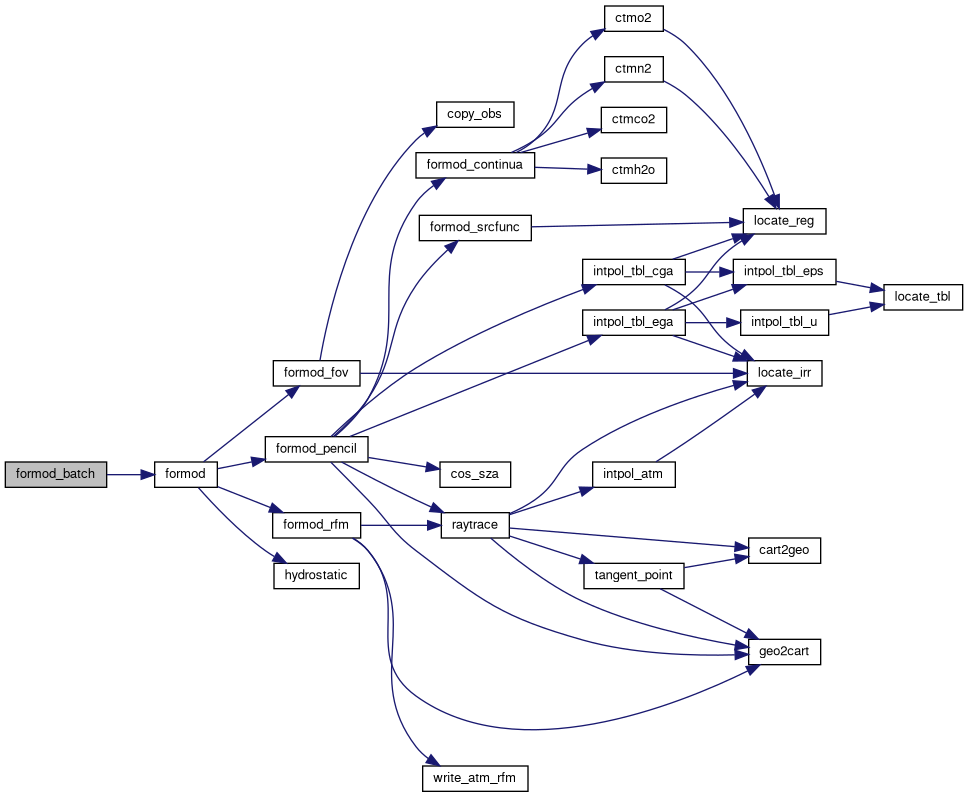
Execute one complete forward-model calculation.
Computes synthetic radiances or brightness temperatures for the given atmospheric state and observation geometry using the selected forward-model method (CGA, EGA, or RFM). The function also applies hydrostatic adjustment, field-of-view convolution, and optional brightness-temperature conversion. Independent cases can be evaluated with formod_batch.
| [in] | ctl | Control structure defining model settings and options. |
| [in] | tbl | Emissivity and source-function lookup tables. |
| [in,out] | atm | Atmospheric profile; may be adjusted for hydrostatic balance. |
| [in,out] | obs | Observation geometry and radiance data; populated with model output. |
| [out] | los_scratch | Caller-provided scratch line-of-sight buffer (one element; must not be shared between concurrent calls). |
| [out] | obs_scratch | Caller-provided scratch observation buffer used by the field-of-view convolution (one element; must not be shared between concurrent calls). |
obs->rad elements marked as invalid (NaN) by applying an internal observation mask stored in obs->mask.Definition at line 3265 of file jurassic.c.
| void formod_batch | ( | const ctl_t * | ctl, |
| const tbl_t * | tbl, | ||
| atm_t * | atm, | ||
| obs_t * | obs, | ||
| const int | nbatch, | ||
| int * | status, | ||
| los_t * | los_scratch, | ||
| obs_t * | obs_scratch | ||
| ) |
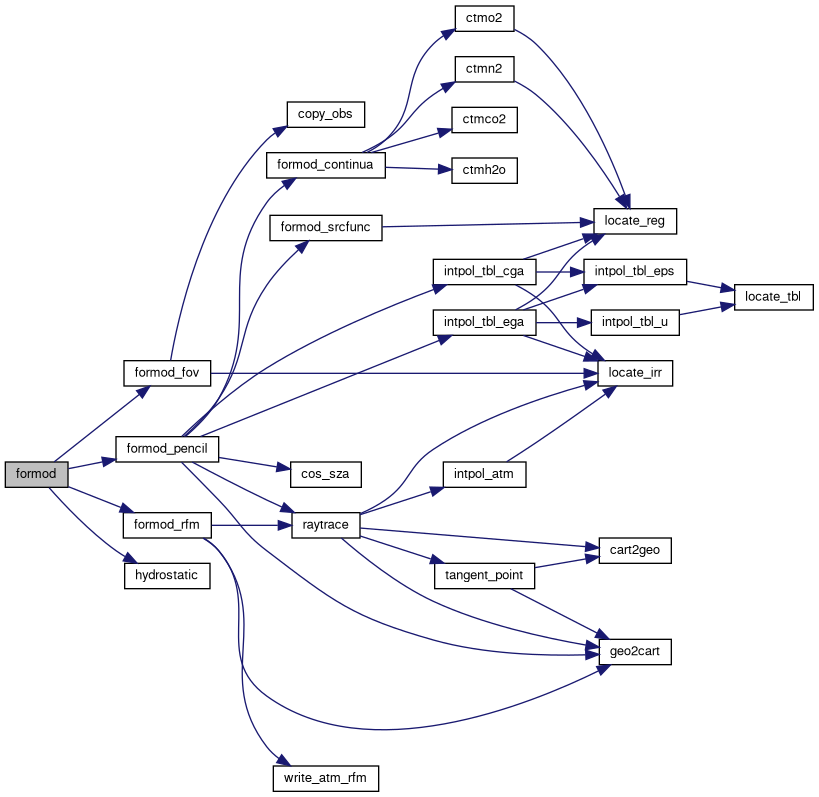
Execute the forward model for a batch of independent cases.
Runs one complete formod calculation for each independent pair of atmospheric and observation states. Cases are evaluated in parallel with OpenMP where applicable (serially for the RFM model).
| [in] | ctl | Control structure. |
| [in] | tbl | Lookup tables. |
| [in,out] | atm | Array of nbatch atmospheres. |
| [in,out] | obs | Array of nbatch observation sets. |
| [in] | nbatch | Number of batch elements. |
| [out] | status | Optional array of nbatch status codes; if NULL, any failure aborts with an error message. |
| [out] | los_scratch | Array of nbatch scratch line-of-sight buffers. |
| [out] | obs_scratch | Array of nbatch scratch observation buffers. |
Definition at line 3316 of file jurassic.c.
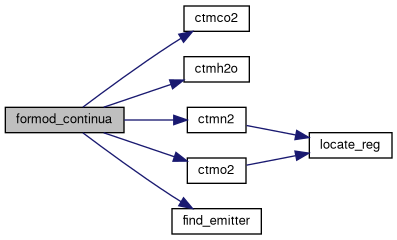
Compute total extinction including gaseous continua.
Calculates the total extinction coefficient for a given line-of-sight point by summing spectrally dependent extinction and optional gaseous continuum contributions (CO₂, H₂O, N₂, O₂).
The function updates the extinction array beta for each spectral channel based on line-by-line extinction and enabled continua flags specified in ctl.
| [in] | ctl | Control structure defining model setup and continuum options. |
| [in] | los | Line-of-sight data containing pressure, temperature, gas concentrations, and extinction coefficients. |
| [in] | ip | Index of the line-of-sight point to process. |
| [out] | beta | Array of total extinction coefficients [km⁻¹] per channel. |
Definition at line 3360 of file jurassic.c.
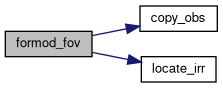
Apply field-of-view (FOV) convolution to modeled radiances.
Convolves pencil-beam radiances and transmittances along each ray path with the instrument field-of-view weighting function defined in the control structure. This simulates finite FOV effects on measured radiances and transmittances.
| [in] | ctl | Control structure containing FOV parameters (offsets ctl_t::fov_dz and weights ctl_t::fov_w). |
| [in,out] | obs | Observation structure; input pencil-beam data are replaced with FOV-convolved radiances and transmittances. |
| [out] | obs_scratch | Scratch observation buffer (overwritten). |
Definition at line 3396 of file jurassic.c.
| int formod_pencil | ( | const ctl_t * | ctl, |
| const tbl_t * | tbl, | ||
| const atm_t * | atm, | ||
| obs_t * | obs, | ||
| const int | ir, | ||
| los_t * | los | ||
| ) |
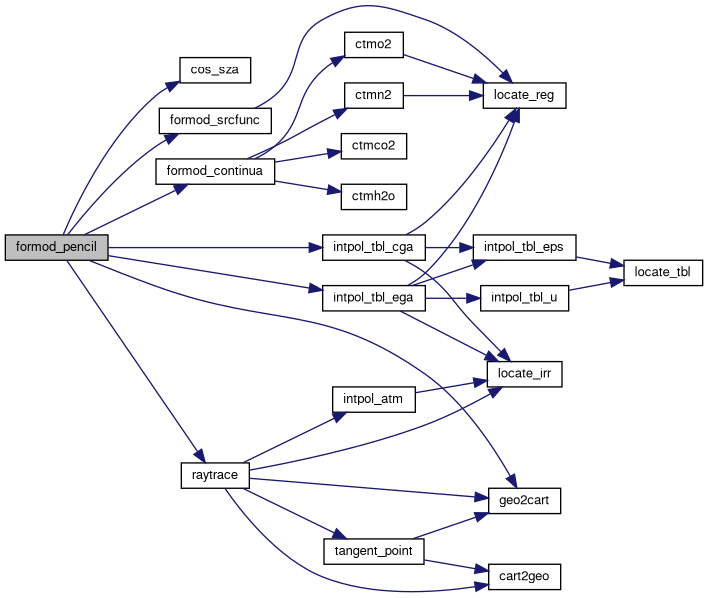
Compute line-of-sight radiances using the pencil-beam forward model.
Simulates monochromatic radiances and transmittances along a single line of sight using a layer-by-layer pencil-beam approximation. The model includes gaseous absorption, continuum extinction, surface emission, reflection, and optional solar illumination.
| [in] | ctl | Control structure defining model configuration, gas setup, surface type, and spectral parameters. |
| [in] | tbl | Emissivity and source-function lookup tables. |
| [in] | atm | Atmospheric state containing pressure, temperature, and gas profiles. |
| [in,out] | obs | Observation data; updated with modeled radiances and transmittances for the specified ray path. |
| [in] | ir | Index of the current ray path in obs. |
| [out] | los | Scratch line-of-sight buffer (zeroed and overwritten). |
Definition at line 3458 of file jurassic.c.
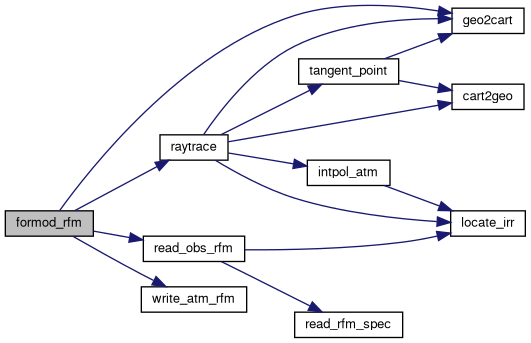
Forward-model radiance and transmittance with the Reference Forward Model (RFM).
This routine provides the JURASSIC interface to the external RFM executable. It writes an RFM atmospheric profile file and a per-channel RFM driver file, runs RFM, and reads back the resulting radiance and transmittance spectra. The spectra are then convolved with the instrument channel filter functions and stored in the observation structure.
Filter functions are taken exclusively from the lookup-table container tbl (i.e., tbl->filt_n, tbl->filt_nu, tbl->filt_f). This makes the behavior independent of the lookup-table format (ASCII, binary, or netCDF) and avoids reliance on external per-channel ASCII filter files.
Viewing geometry is classified as one of:
Mixed geometries (e.g., limb and nadir simultaneously) are not allowed and will trigger an error.
Limitations:
rfm.atm, rfm.drv, rad_*.asc, tra_*.asc) and removes them on completion.| [in] | ctl | Control and configuration parameters (RFM binary path, HITRAN/XSC settings, channel definitions, flags such as refraction and continua). |
| [in] | tbl | Lookup-table container providing per-channel filter functions. |
| [in] | atm | Atmospheric state (altitude grid, temperature, and gas profiles). |
| [out] | obs | Observation geometry and output arrays; on return, obs->rad[id][ir] and obs->tau[id][ir] are filled for all channels and rays. |
tbl contains valid filter functions for all channels used (tbl->filt_n[id] > 0). obsz/obslon/obslat). atm->k == 0 for all wavelengths/levels).obs->rad and obs->tau are updated with channel-integrated radiance and transmittance computed by RFM.system(), and creates/removes files in the current working directory.Definition at line 3642 of file jurassic.c.
Interpolate the source function (Planck radiance) at a given temperature.
Computes source function values by linearly interpolating between precomputed Planck radiances in the lookup table. The resulting radiance spectrum corresponds to the input temperature and is stored in src for all spectral channels.
| [in] | ctl | Control structure defining the number of spectral channels. |
| [in] | tbl | Emissivity and source-function lookup table containing Planck radiances (tbl_t::sr) and corresponding temperatures (tbl_t::st). |
| [in] | t | Temperature [K] for which the source function is evaluated. |
| [out] | src | Output array of interpolated source-function values [W·m⁻²·sr⁻¹·cm⁻¹] per spectral channel. |
Definition at line 3842 of file jurassic.c.

| void geo2cart | ( | const double | z, |
| const double | lon, | ||
| const double | lat, | ||
| double * | x | ||
| ) |
Converts geographic coordinates (longitude, latitude, altitude) to Cartesian coordinates.
This function converts geographic coordinates specified by longitude, latitude, and altitude into Cartesian coordinates. The Earth is approximated as a sphere with radius defined by the constant RE.
| z | The altitude above the Earth's surface in kilometers. |
| lon | The longitude in degrees. |
| lat | The latitude in degrees. |
| x | Pointer to an array of three doubles where the computed Cartesian coordinates (x, y, z) will be stored. |
The function computes the Cartesian coordinates using the given altitude, longitude, and latitude. It assumes the Earth is a perfect sphere and uses the following formulas:
RE is defined as the Earth's radius in kilometers. Definition at line 3859 of file jurassic.c.
Adjust pressure profile using the hydrostatic equation.
Recomputes the atmospheric pressure field to ensure hydrostatic equilibrium with respect to altitude and temperature. Starting from a reference altitude (ctl_t::hydz), the routine integrates the hydrostatic balance equation both upward and downward through the profile using small interpolation steps.
The air density is corrected for humidity using the mean molecular mass of dry air and water vapor.
| [in] | ctl | Control structure providing model constants and reference altitude (ctl_t::hydz) and H₂O index (ctl_t::ig_h2o). |
| [in,out] | atm | Atmospheric state; input temperatures, heights, and humidities are used to update pressure [hPa]. |
Definition at line 3877 of file jurassic.c.
| void idx2name | ( | const ctl_t * | ctl, |
| const int | idx, | ||
| char * | quantity | ||
| ) |
Convert a quantity index to a descriptive name string.
Translates a model quantity index (e.g., pressure, temperature, gas mixing ratio, extinction, or surface parameter) into a human-readable name. The function uses the index mapping defined in the control structure to assign appropriate labels.
| [in] | ctl | Control structure containing gas, window, cloud, and surface setup information. |
| [in] | idx | Quantity index (see IDXP, IDXT, IDXQ, IDXK, etc.). |
| [out] | quantity | Character buffer to receive the descriptive quantity name (e.g., "PRESSURE", "H2O", "CLOUD_HEIGHT", "SURFACE_EMISSIVITY_1000.0"). |
quantity using sprintf(). The caller must ensure sufficient buffer size (≥ LEN).Definition at line 3937 of file jurassic.c.
Initialize source function lookup tables from emissivity data.
This function computes channel-dependent source function lookup tables based on the spectral filter functions and the Planck function. For each spectral channel, the Planck radiance is integrated over the corresponding filter function and stored as a function of temperature.
The resulting source function table represents the band-integrated thermal emission associated with the emissivity lookup tables and is later used in radiative transfer calculations.
The temperature grid is uniformly sampled between TMIN and TMAX with TBLNS points. The spectral integration is performed on the finest frequency spacing present in the filter function.
| [in] | ctl | Pointer to the control structure defining the number of channels and their central wavenumbers. |
| [in,out] | tbl | Pointer to the lookup-table structure in which the source function tables and temperature grid are stored. |
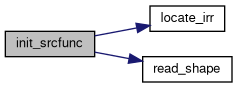
Definition at line 3976 of file jurassic.c.
| void intpol_atm | ( | const ctl_t * | ctl, |
| const atm_t * | atm, | ||
| const double | z, | ||
| double * | p, | ||
| double * | t, | ||
| double * | q, | ||
| double * | k | ||
| ) |
Interpolate atmospheric state variables at a given altitude.
Computes pressure, temperature, volume mixing ratios, and extinction coefficients at the specified altitude by interpolating between adjacent model levels in the atmospheric profile.
| [in] | ctl | Control structure defining the number of gases (ctl_t::ng) and spectral windows (ctl_t::nw). |
| [in] | atm | Atmospheric profile providing altitude, pressure, temperature, gas mixing ratios, and extinction data. |
| [in] | z | Target altitude [km]. |
| [out] | p | Interpolated pressure [hPa]. |
| [out] | t | Interpolated temperature [K]. |
| [out] | q | Interpolated gas volume mixing ratios [ppv], length ctl_t::ng. |
| [out] | k | Interpolated extinction coefficients [km⁻¹], length ctl_t::nw. |
Definition at line 4023 of file jurassic.c.

| void intpol_tbl_cga | ( | const ctl_t * | ctl, |
| const tbl_t * | tbl, | ||
| const los_t * | los, | ||
| const int | ip, | ||
| double | tau_path[ND][NG], | ||
| double | tau_seg[ND] | ||
| ) |
Interpolate emissivities and transmittances using the Curtis–Godson approximation (CGA).
Computes gas transmittance along a line-of-sight segment by interpolating precomputed emissivity values from lookup tables. The interpolation is performed in pressure, temperature, and column density space using bilinear (in p, T) and logarithmic (in p) interpolation.
| [in] | ctl | Control structure defining number of gases (ctl_t::ng) and channels (ctl_t::nd). |
| [in] | tbl | Emissivity lookup tables (tbl_t) containing tabulated pressure, temperature, and column density grids. |
| [in] | los | Line-of-sight structure providing Curtis–Godson mean parameters and column densities. |
| [in] | ip | Index of the current LOS point. |
| [in,out] | tau_path | Path transmittance array [nd][ng]; updated cumulatively for each gas. |
| [out] | tau_seg | Total segment transmittance per channel [nd]. |
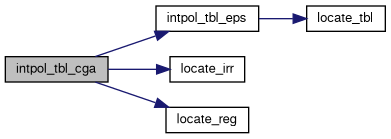
tbl->eps) for each gas and channel.Definition at line 4048 of file jurassic.c.
| void intpol_tbl_ega | ( | const ctl_t * | ctl, |
| const tbl_t * | tbl, | ||
| const los_t * | los, | ||
| const int | ip, | ||
| double | tau_path[ND][NG], | ||
| double | tau_seg[ND] | ||
| ) |
Interpolate emissivities and transmittances using the Emissivity Growth Approximation (EGA).
Computes gas transmittance along a line-of-sight segment by interpolating emissivity values from lookup tables based on the Emissivity Growth Approximation (EGA). The interpolation is performed in pressure, temperature, and effective column density space derived from the local LOS properties.
| [in] | ctl | Control structure defining number of gases (ctl_t::ng) and channels (ctl_t::nd). |
| [in] | tbl | Emissivity lookup tables (tbl_t) containing tabulated pressure, temperature, and column density grids. |
| [in] | los | Line-of-sight structure providing local pressure, temperature, and column density data. |
| [in] | ip | Index of the current LOS point. |
| [in,out] | tau_path | Path transmittance array [nd][ng]; updated cumulatively for each gas. |
| [out] | tau_seg | Total segment transmittance per channel [nd]. |
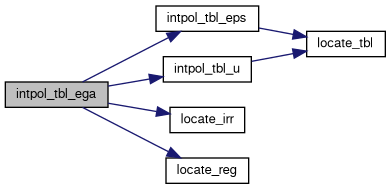
tbl->eps) and performs bilinear interpolation in pressure and temperature.Definition at line 4141 of file jurassic.c.
|
inline |
Interpolate gas emissivity as a function of column amount.
Computes emissivity \(\varepsilon(u)\) from tabulated data using linear interpolation in \(\log u\)– \(\log\varepsilon\) space. The input column amount must be provided as \(\log(u)\).
Behavior:
The implementation uses log1p/expm1 for numerical stability and minimizes conversions between linear and logarithmic space.
| tbl | Lookup table structure. |
| ig | Gas index. |
| id | Spectral/channel index. |
| ip | Pressure index. |
| it | Temperature index. |
| logu | Natural logarithm of the column amount [molecules/cm²]. |
Definition at line 4243 of file jurassic.c.

|
inline |
Interpolate column amount as a function of emissivity.
Computes the column amount \(u(\varepsilon)\) from tabulated data using linear interpolation in \(\log\varepsilon\)– \(\log u\) space. The emissivity must be provided as \(\log(\varepsilon)\) together with \(\log(1-\varepsilon)\).
Behavior:
intpol_tbl_eps() is analytically inverted.The implementation operates primarily in log-space and uses log1p for numerical stability near \(\varepsilon \rightarrow 1\).
| tbl | Lookup table structure. |
| ig | Gas index. |
| id | Spectral/channel index. |
| ip | Pressure index. |
| it | Temperature index. |
| logeps | Natural logarithm of emissivity ( \(\log\varepsilon\)). |
Definition at line 4288 of file jurassic.c.

| void jsec2time | ( | const double | jsec, |
| int * | year, | ||
| int * | mon, | ||
| int * | day, | ||
| int * | hour, | ||
| int * | min, | ||
| int * | sec, | ||
| double * | remain | ||
| ) |
Converts Julian seconds to calendar date and time components.
This function converts Julian seconds to calendar date and time components, including year, month, day, hour, minute, and second. It also calculates the fractional part of the seconds.
| jsec | Julian seconds to convert. |
| year | Pointer to store the year. |
| mon | Pointer to store the month. |
| day | Pointer to store the day. |
| hour | Pointer to store the hour. |
| min | Pointer to store the minute. |
| sec | Pointer to store the second. |
| remain | Pointer to store the fractional part of seconds. |
The function initializes a time structure t0 with a fixed starting date and time. It then converts the Julian seconds to a time_t type by adding the seconds to the epoch time. Next, it converts the time_t value to a UTC time structure t1. Finally, it extracts the year, month, day, hour, minute, and second components from t1 and calculates the fractional part of seconds, which is stored in remain.
Definition at line 4334 of file jurassic.c.
Compute the Jacobian (kernel) matrix by finite differences.
Evaluates the sensitivity of the simulated radiances to each element of the atmospheric state vector by perturbing one parameter at a time and re-running the forward model. Independent perturbed states are prepared in batches and evaluated through formod_batch. The resulting Jacobian matrix is \( K = \partial y / \partial x \), where y is the measurement vector and x is the state vector.
| [in] | ctl | Control structure defining retrieval configuration and model setup. |
| [in] | tbl | Emissivity lookup tables used by the forward model. |
| [in,out] | atm | Atmospheric state and profile data; may be adjusted for hydrostatic balance. |
| [in,out] | obs | Observation geometry and radiance data; populated with the undisturbed forward-model result. |
| [out] | k | Jacobian matrix [m×n], where m is the number of measurements and n the number of state variables. |
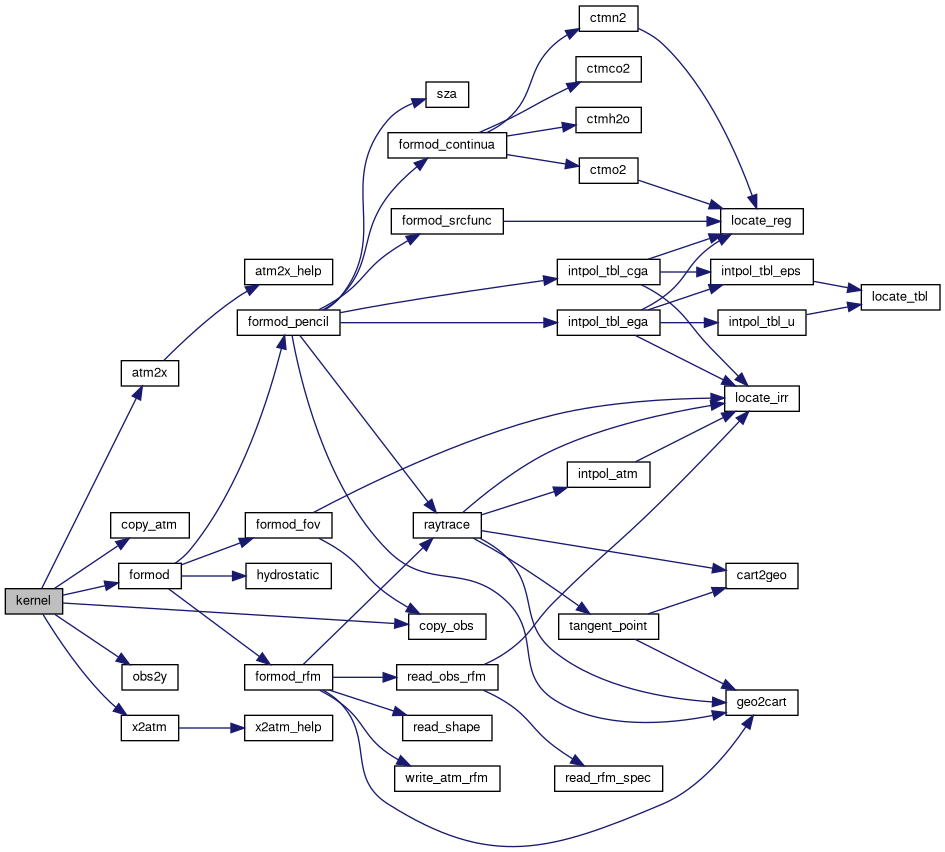
h depending on its physical type (pressure, temperature, VMR, etc.).Definition at line 4367 of file jurassic.c.
| int locate_irr | ( | const double * | xx, |
| const int | n, | ||
| const double | x | ||
| ) |
Locate index for interpolation on an irregular grid.
Finds the lower index ilo such that \( xx[ilo] \le x < xx[ilo+1] \) for monotonically increasing or decreasing grids.
Used in interpolation routines for altitude, pressure, temperature, or wavenumber profiles that are not evenly spaced.
| [in] | xx | Array of monotonic grid values (increasing or decreasing). |
| [in] | n | Number of grid points. |
| [in] | x | Target value to locate within the grid range. |
ilo of the lower grid point surrounding x.x lies within the range of xx; no bounds checking beyond the first and last grid points is performed.Definition at line 4489 of file jurassic.c.
| int locate_reg | ( | const double * | xx, |
| const int | n, | ||
| const double | x | ||
| ) |
Locate index for interpolation on a regular (uniform) grid.
Computes the lower index i such that \( xx[i] \le x < xx[i+1] \) for evenly spaced grid points. Used for quick index lookup when the grid spacing is constant.
| [in] | xx | Array of regularly spaced grid values. |
| [in] | n | Number of grid points. |
| [in] | x | Target value to locate within the grid range. |
i of the lower grid point surrounding x.[0, n - 2] to avoid out-of-bounds indices.Definition at line 4519 of file jurassic.c.
|
inline |
Locate index for interpolation within emissivity table grids.
Finds the lower index ilo such that \( xx[ilo] \le x < xx[ilo+1] \) in a monotonically increasing single-precision grid.
Used for emissivity and column density interpolation in table-based routines such as intpol_tbl_eps and intpol_tbl_u.
| [in] | xx | Monotonic (increasing) single-precision grid array. |
| [in] | n | Number of grid points. |
| [in] | x | Target value to locate within the grid range. |
ilo of the lower grid point surrounding x.float to minimize memory use.x lies within the table range.Definition at line 4538 of file jurassic.c.
| void matrix_invert | ( | gsl_matrix * | a | ) |
Invert a square matrix, optimized for diagonal or symmetric positive-definite matrices.
Performs in-place inversion of the matrix \(\mathbf{A}\) using either:
| [in,out] | a | Square matrix (gsl_matrix) to be inverted in place. |
The function first checks whether the input matrix is diagonal by testing all off-diagonal elements. If diagonal, each diagonal element \(a_{ii}\) is replaced by its reciprocal \(1/a_{ii}\).
For non-diagonal matrices, a Cholesky decomposition is performed:
\[ \mathbf{A} = \mathbf{L}\mathbf{L}^T \]
followed by inversion using the Cholesky factors, yielding \(\mathbf{A}^{-1}\).
This approach assumes \(\mathbf{A}\) is symmetric and positive-definite.
Definition at line 4560 of file jurassic.c.
| void matrix_product | ( | const gsl_matrix * | a, |
| const gsl_vector * | b, | ||
| const int | transpose, | ||
| gsl_matrix * | c | ||
| ) |
Compute structured matrix products of the form \(A^T B A\) or \(A B A^T\).
Evaluates matrix products commonly used in covariance propagation and optimal estimation, depending on the specified transpose mode:
The vector \(\mathbf{b}\) represents the diagonal elements of \(\mathbf{B}\), i.e. a diagonal weighting or covariance matrix.
| [in] | a | Input matrix \(\mathbf{A}\) (size m×n). |
| [in] | b | Vector representing the diagonal of \(\mathbf{B}\) (length m or n). |
| [in] | transpose | Operation selector:
|
| [out] | c | Output matrix to store the resulting product. |
dgemm routines for efficiency: \[ A^T B A = (B^{1/2}A)^T (B^{1/2}A), \quad A B A^T = (A B^{1/2}) (A B^{1/2})^T \]
transpose is not 1 or 2, the function performs no operation.Definition at line 4590 of file jurassic.c.
Convert observation radiances into a measurement vector.
Extracts all finite radiance values from the observation structure and stores them sequentially in a GSL vector.
Optionally records detector (id) and ray path (ir) indices for each measurement element.
| [in] | ctl | Control structure containing observation setup (e.g. number of detectors). |
| [in] | obs | Observation data structure containing radiances. |
| [out] | y | Measurement vector to store radiances (may be NULL). |
| [out] | ida | Optional array to store detector indices (may be NULL). |
| [out] | ira | Optional array to store ray path indices (may be NULL). |
nd) and ray paths (nr).NaN or Inf) radiance values.ida and ira must be preallocated with sufficient size to hold all finite radiances if provided.Definition at line 4635 of file jurassic.c.
| void optimal_estimation | ( | ret_t * | ret, |
| ctl_t * | ctl, | ||
| tbl_t * | tbl, | ||
| obs_t * | obs_meas, | ||
| obs_t * | obs_i, | ||
| atm_t * | atm_apr, | ||
| atm_t * | atm_i, | ||
| double * | chisq | ||
| ) |
Perform optimal estimation retrieval using Levenberg–Marquardt minimization.
This function performs an optimal estimation of atmospheric state variables based on measured observations, a priori information, and forward radiative transfer modeling. The estimation follows the Rodgers (2000) formalism and uses a Levenberg–Marquardt algorithm to iteratively minimize the cost function:
χ² = (x - x_a)^T S_a⁻¹ (x - x_a) + (y - F(x))^T S_ε⁻¹ (y - F(x)),
where x is the atmospheric state vector, x_a is its a priori estimate, S_a is the a priori covariance matrix, y is the measurement vector, F(x) is the forward model, and S_ε is the measurement error covariance.
The routine updates the atmospheric state until convergence criteria are met or the maximum number of iterations is reached. Optionally, the full retrieval error budget and averaging kernel analysis are computed.
| [out] | ret | Retrieval configuration and output container. Determines convergence, kernel recomputation frequency, and error analysis options. |
| [in] | ctl | Control parameters describing problem setup (grids, species, etc.). |
| [in] | tbl | Lookup tables required by the forward model. |
| [in] | obs_meas | Measured observations used as input. |
| [out] | obs_i | Intermediate and final modeled observations corresponding to the retrieved state. |
| [in] | atm_apr | A priori atmospheric state used as reference. |
| [out] | atm_i | Atmospheric state vector to be iteratively retrieved and updated. |
| [out] | chisq | Final value of the cost function (χ²) upon convergence. |
ret->err_ana), the function produces:Definition at line 4662 of file jurassic.c.
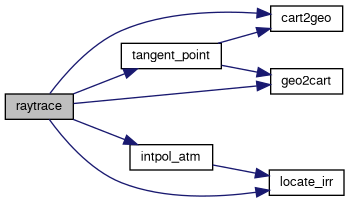
Perform line-of-sight (LOS) ray tracing through the atmosphere.
Computes the geometric path of a viewing ray from the observer to the atmosphere (and possibly the surface), accounting for spherical geometry, optional refraction, and cloud or surface interactions.
Fills the LOS structure with pressure, temperature, gas concentrations, extinction, and path length at each step.
| [in] | ctl | Control structure containing model and numerical settings. |
| [in] | atm | Atmospheric state structure (profiles of p, T, q, k, etc.). |
| [in,out] | obs | Observation geometry and radiance data; updated tangent point. |
| [out] | los | Line-of-sight structure to be populated with sampled quantities. |
| [in] | ir | Index of the current ray path in the observation set. |
NLOS.ds determined by altitude and user-specified controls (rayds, raydz).n(p, T) based on an Edlen-type relation evaluated at a fixed reference wavelength of 10 um, consistent with the published RFM algorithm.NLOS.Definition at line 4986 of file jurassic.c.
| void read_atm | ( | const char * | dirname, |
| const char * | filename, | ||
| const ctl_t * | ctl, | ||
| atm_t * | atm, | ||
| int | profile | ||
| ) |
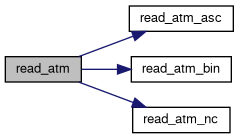
Read atmospheric input data from a file.
This function reads atmospheric data from the file specified by filename, optionally prefixed by the directory dirname. The file format (ASCII or binary) is determined by the control structure ctl. The data are stored in the atmospheric structure atm.
Supported file formats are:
ctl->atmfmt == 1)ctl->atmfmt == 2)The function initializes the atmospheric data container, opens the specified file, reads its contents according to the selected format, and performs sanity checks on the number of data points. It also logs basic statistical information about the loaded atmospheric fields (time, altitude, longitude, latitude, pressure, temperature, and species/emitter mixing ratios).
| dirname | Optional directory path where the atmospheric file resides. If NULL, only filename is used. |
| filename | Name of the atmospheric data file to read. |
| ctl | Pointer to a control structure specifying input parameters, file format, number of emitters, spectral windows, and additional atmospheric configuration. |
| atm | Pointer to an atmospheric data structure that will be filled with the values read from the file. The structure must be allocated before calling this function. |
| profile | Zero-based profile index for netCDF input. Ignored for ASCII and binary formats. |
atm structure has been properly allocated, and that the control parameters in ctl are valid before calling this function.Definition at line 5219 of file jurassic.c.
Read atmospheric data in ASCII format.
This function reads and parses atmospheric input data from an ASCII file specified by its filename and stores the values in the atmospheric structure atm. The number and type of fields to read are determined by the control structure ctl. Each line of the ASCII file corresponds to a single atmospheric data point.
The expected order of fields in each line is:
ctl->ng values)ctl->nw values)Additionally, if cloud or surface layer parameters are enabled in ctl, they are read once from the first line only:
ctl->ncl values)ctl->nsf values)| filename | Path to the ASCII file containing atmospheric data. |
| ctl | Pointer to a control structure defining the number of gases, spectral windows, and whether cloud or surface layer information should be read. |
| atm | Pointer to an initialized atmospheric structure where the parsed data points will be stored. The function updates atm->np to reflect the number of successfully read data records. |
ERRMSG if more than NP data points are encountered, or if the input format deviates from expectations.Definition at line 5293 of file jurassic.c.
Read atmospheric data in binary format.
This function reads atmospheric input data from a binary file specified by its filename and stores the decoded values in the atmospheric structure atm. The expected binary format is predefined and must match the configuration provided in the control structure ctl. The function reads a header containing metadata describing the dataset, followed by the atmospheric fields and optional cloud and surface layer properties.
The binary file layout is expected to follow this structure:
ng)nw)ncl)nsf) These must match the corresponding values in ctl.np)np for time, altitude, longitude, latitude, pressure, and temperaturenp np ctl->ncl values)ctl->nsf values)| filename | Path to the binary file containing atmospheric data. |
| ctl | Pointer to a control structure specifying the expected dimensions of atmospheric fields and optional layers. Used for header validation. |
| atm | Pointer to an allocated atmospheric data structure that will be filled with the contents of the binary file. All arrays must be allocated prior to calling this function. |
ERRMSG if:Definition at line 5344 of file jurassic.c.
Read one atmospheric profile from a netCDF file.
This routine reads a single profile (record) from a netCDF file into an atm_t structure. The file is expected to follow the JURASSIC netCDF layout produced by write_atm_nc(), using an unlimited profile dimension and a fixed level dimension.
The number of valid vertical levels for the requested profile is read from nlev(profile) and stored in atm->np. All 2-D profile variables are then read for the hyperslab (profile,0:atm->np-1).
Dimensions:
profile : unlimited (record dimension)level : fixed (maximum number of vertical levels stored in the file)Variables:
nlev(profile) : number of valid levels per profile (required)time,z,lon,lat,p,t(profile,level)ctl->emitter[ig] with dimensions ext_win_d(profile,level)ctl->ncl>0): cld_z, cld_dz, cld_k_%.4f(profile)ctl->nsf>0): srf_t, srf_eps_%.4f(profile)| filename | Input netCDF file name. |
| ctl | Control structure (defines numbers/names of optional fields, e.g., ng, nw, ncl, nsf, and emitter[]). |
| atm | Atmospheric profile structure to fill. On return, atm->np contains the number of valid levels for the requested profile. |
| profile | Record index along the unlimited profile dimension. |
atm have static capacity NP and checks that atm->np is within NC(...) macro.Definition at line 5438 of file jurassic.c.
| void read_ctl | ( | int | argc, |
| char * | argv[], | ||
| ctl_t * | ctl | ||
| ) |
Read model control parameters from command-line and configuration input.
Parses all numerical and string parameters required to initialize a JURASSIC simulation, including atmospheric composition, radiative channels, cloud and surface options, continua, ray-tracing setup, retrieval parameters, and output settings.
Populates the ctl_t structure with all configuration values.
| [in] | argc | Argument count from the command line. |
| [in] | argv | Argument vector containing user-specified options. |
| [out] | ctl | Control structure to be filled with parsed settings. |
NG, EMITTER),ND, NU, WINDOW),NCL, CLNU),NSF, SFNU, SFTYPE, SFSZA),HYDZ),CTM_CO2, CTM_H2O, CTM_N2, CTM_O2),REFRAC, RAYDS, RAYDZ),FOV),RETP_ZMIN, RETQ_ZMAX, etc.),WRITE_BBT, WRITE_MATRIX),RFMBIN, RFMHIT, RFMXSC).NG > NG_MAX).NCL > 1, NSF > 1).ERRMSG() aborts.Definition at line 5542 of file jurassic.c.

| void read_matrix | ( | const char * | dirname, |
| const char * | filename, | ||
| const ctl_t * | ctl, | ||
| gsl_matrix * | matrix, | ||
| int | dataset | ||
| ) |
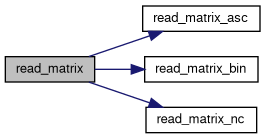
Read a numerical matrix from a file.
Dispatches matrix input according to the configured matrix file format. Supported formats are ASCII (MATRIXFMT=1), binary (MATRIXFMT=2), and netCDF (MATRIXFMT=3).
| [in] | dirname | Directory path containing the matrix file (may be NULL). |
| [in] | filename | Name of the matrix file to read. |
| [in] | ctl | Control structure defining the matrix file format. |
| [out] | matrix | Pointer to the GSL matrix to be filled with values. |
| [in] | dataset | Zero-based dataset index for netCDF input. Ignored for ASCII and binary formats. |
Definition at line 5669 of file jurassic.c.
| void read_matrix_asc | ( | const char * | dirname, |
| const char * | filename, | ||
| gsl_matrix * | matrix | ||
| ) |
Read a numerical matrix from an ASCII file.
Loads values into a GSL matrix from a text file containing sparse or indexed entries in tabular format.
Each valid line is parsed for row and column indices and the corresponding value.
| [in] | dirname | Directory path containing the matrix file (may be NULL). |
| [in] | filename | Name of the matrix file to read. |
| [out] | matrix | Pointer to the GSL matrix to be filled with values. |
gsl_matrix_set().Definition at line 5695 of file jurassic.c.
| void read_matrix_bin | ( | const char * | dirname, |
| const char * | filename, | ||
| gsl_matrix * | matrix | ||
| ) |
Read a numerical matrix from a binary file.
Loads values into a GSL matrix from a compact binary file containing a magic identifier, matrix dimensions, and all matrix elements in row-major order.
| [in] | dirname | Directory path containing the matrix file (may be NULL). |
| [in] | filename | Name of the matrix file to read. |
| [out] | matrix | Pointer to the preallocated GSL matrix to be filled. |
matrix.Definition at line 5734 of file jurassic.c.
| void read_matrix_nc | ( | const char * | dirname, |
| const char * | filename, | ||
| gsl_matrix * | matrix, | ||
| int | dataset | ||
| ) |
Read a numerical matrix from a netCDF file.
Loads one matrix record into a GSL matrix from a netCDF file containing an unlimited dimension dataset, fixed dimensions row and col, and a variable matrix(dataset,row,col). The schema also stores per-dataset selectors rowspace, colspace, and sort, along with per-row and per-column metadata variables for channel wavenumber, time, position, and state quantity names.
| [in] | dirname | Directory path containing the matrix file (may be NULL). |
| [in] | filename | Name of the matrix file to read. |
| [out] | matrix | Pointer to the preallocated GSL matrix to be filled. |
| [in] | dataset | Zero-based index along the unlimited dataset dimension. |
matrix.Definition at line 5787 of file jurassic.c.
| void read_obs | ( | const char * | dirname, |
| const char * | filename, | ||
| const ctl_t * | ctl, | ||
| obs_t * | obs, | ||
| int | profile | ||
| ) |
Read observation data from an input file.
This function reads atmospheric observation data from the specified file and stores the results in the provided obs_t structure. The file may be in ASCII or binary format, depending on the control settings passed via ctl_t. After reading the data, the routine performs basic validation (e.g., verifies that at least one observation entry was loaded) and logs diagnostic statistics such as ranges of times, observer coordinates, view point coordinates, tangent point coordinates, radiance or brightness temperature values, and transmittances.
The input file path is constructed from the provided directory and filename. If a directory name is given, the file is assumed to reside within it; otherwise, the filename is used as-is. Depending on the value of ctl->obsfmt, the function dispatches either to read_obs_asc() for ASCII files or read_obs_bin() for binary files.
| [in] | dirname | Directory containing the input file, or NULL to use only filename. |
| [in] | filename | Name of the observation file to read. |
| [in] | ctl | Pointer to a control structure specifying file format and other options. |
| [out] | obs | Pointer to an observation structure where the data will be stored. |
| [in] | profile | Zero-based profile index for netCDF input. Ignored for ASCII and binary formats. |
obs structure must be properly allocated before calling this function. The function assumes its arrays are large enough to store all values contained in the input file.Definition at line 5836 of file jurassic.c.
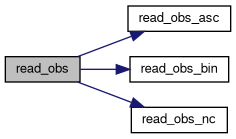
Read ASCII-formatted observation data from a file.
This function reads atmospheric observation data from an ASCII text file specified by its filename and stores it in the provided obs_t structure. Each line in the input file is expected to contain numerical values representing a single observation record, including time, observer coordinates, view point coordinates, tangent point coordinates, spectral values stored as radiance or brightness temperature depending on ctl->write_bbt, and transmittances. The number of spectral-value and transmittance columns per record is determined by ctl->nd.
The function reads the file line by line, tokenizes the data fields, and fills the corresponding observation arrays. The number of successfully read observation entries is stored in obs->nr.
| filename | Path to the ASCII file containing the observation data. |
| ctl | Control structure containing metadata such as the number of spectral channels (nd). |
| obs | Observation structure where the parsed data will be stored. |
obs structure has been preallocated with sufficient space for all records and spectral channels. No memory allocation is performed inside this routine.NR.Definition at line 5911 of file jurassic.c.
Read binary-formatted observation data from a file.
This C function reads observation data stored in a compact binary format from a file specified by its filename and initializes the provided obs_t structure with the values retrieved. The binary format begins with a header that contains a magic identifier and the expected number of spectral channels. The number of channels in the file must match ctl->nd, otherwise the routine aborts with an error.
After verifying the header, the function reads the number of ray paths and then sequentially loads arrays corresponding to observation time, observer location, view point location, tangent point location, spectral values stored as radiance or brightness temperature depending on ctl->write_bbt, and transmittance data. The number of ray paths is assigned to obs->nr. All arrays must have been allocated prior to calling this function.
| filename | Path to the binary file containing the observation data. |
| ctl | Pointer to a control structure specifying the number of spectral channels (nd) and other configuration settings. |
| obs | Pointer to an observation structure where the decoded binary data will be stored. |
obs have sufficient capacity for the data being read.NR is encountered, or if any read operation fails.Definition at line 5955 of file jurassic.c.
Read one observation profile from a NetCDF file.
This function reads all geometric and spectral observation data for a single profile from a NetCDF file using the variable-per-channel layout.
The NetCDF file is expected to contain:
profile (unlimited)ray (number of ray paths)nray(profile) giving the number of rays for each profiletime, obs_z, obs_lon, obs_lat vp_z, vp_lon, vp_lat tp_z, tp_lon, tp_lat rad_%.4f (radiance, if ctl->write_bbt == 0)bt_%.4f (brightness temperature, if ctl->write_bbt != 0)tau_%.4f (transmittance) where the formatted frequency corresponds to ctl->nu[id].All data for the selected profile are read into the supplied obs_t structure. The number of rays is read from nray(profile) and stored in obs->nr. If the number of rays exceeds NR or is less than one, an error is raised.
| filename | Path to the NetCDF observation file. |
| ctl | Pointer to the control structure defining spectral channels. |
| obs | Pointer to the observation structure to be filled. |
| profile | Zero-based index of the profile to read. |
Definition at line 6033 of file jurassic.c.
| double read_obs_rfm | ( | const char * | basename, |
| const double | z, | ||
| const double * | nu, | ||
| const double * | f, | ||
| const int | n | ||
| ) |
Read and spectrally convolve an RFM output spectrum.
Opens the appropriate RFM ASCII spectrum file for a given tangent or observation altitude and convolves the high-resolution spectrum with a provided instrument filter function.
Returns the integrated (filtered) radiance value.
| [in] | basename | Base filename of the RFM output (e.g. "rad" or "tra"). |
| [in] | z | Altitude [km] used to select the corresponding RFM file. |
| [in] | nu | Wavenumber grid [cm⁻¹] of the filter function. |
| [in] | f | Filter transmission values corresponding to nu. |
| [in] | n | Number of points in nu and f arrays. |
basename_<altitude_in_meters>.asc (e.g. rad_04500.asc).nurfm) and radiances (rad).\[ R = \frac{\int f(\nu) \, I(\nu) \, d\nu}{\int f(\nu) \, d\nu} \]
nu and f arrays are monotonic and have at least two points.Definition at line 6112 of file jurassic.c.
Read retrieval configuration and error parameters.
Initializes the retrieval control structure (ret_t) by reading all iteration and uncertainty parameters from the command line or an input control file using the scan_ctl() interface.
| [in] | argc | Number of command-line arguments. |
| [in] | argv | Command-line argument vector. |
| [in] | ctl | Pointer to global control structure (ctl_t) defining the number of emitters, detectors, windows, clouds, etc. |
| [out] | ret | Pointer to retrieval configuration structure (ret_t) to be populated with iteration and error settings. |
The function performs the following initialization steps:
KERNEL_RECOMP — number of iterations between kernel recomputations. CONV_ITMAX — maximum number of retrieval iterations. CONV_DMIN — minimum normalized step size for convergence.SHARED_IO_PROFLIST — optional file containing profile indices for batch mode.SHARED_IO_ATM_APR_FILE, SHARED_IO_OBS_MEAS_FILE — optional shared input files.SHARED_IO_ATM_FINAL_FILE, SHARED_IO_OBS_FINAL_FILE — optional shared output files.SHARED_IO_MATRIX_*_FILE, SHARED_IO_ATM_ERR_*_FILE, SHARED_IO_ATM_CONT_FILE, SHARED_IO_ATM_RES_FILE — optional shared diagnostic output files.ERR_ANA — enables or disables retrieval error analysis (0 = off, 1 = on).ERR_FORMOD[id] — relative (%) forward model uncertainty per detector channel. ERR_NOISE[id] — absolute instrument noise per detector channel write_bbt.ERR_PRESS, ERR_PRESS_CZ, ERR_PRESS_CH — pressure error [%] and correlation lengths [km]. ERR_TEMP, ERR_TEMP_CZ, ERR_TEMP_CH — temperature error [K] and correlation lengths [km].ERR_Q[ig], ERR_Q_CZ[ig], ERR_Q_CH[ig] — per gas [%] and correlation lengths [km].ERR_K[iw], ERR_K_CZ[iw], ERR_K_CH[iw] — per spectral window [km⁻¹] and correlation lengths [km].ERR_CLZ — cloud top height error [km]. ERR_CLDZ — cloud depth error [km]. ERR_CLK[icl] — cloud extinction error per frequency [km⁻¹].ERR_SFT — surface temperature error [K]. ERR_SFEPS[isf] — surface emissivity errors (dimensionless).-999 indicate uncorrelated (diagonal) treatment.ctl and ret dimensions.Definition at line 6144 of file jurassic.c.

| void read_rfm_spec | ( | const char * | filename, |
| double * | nu, | ||
| double * | rad, | ||
| int * | npts | ||
| ) |
Read a Reference Forward Model (RFM) ASCII spectrum.
Parses an RFM output file containing high-resolution spectral radiances and fills the provided arrays with wavenumber and radiance values.
| [in] | filename | Name of the RFM ASCII spectrum file (e.g. "rad_04500.asc"). |
| [out] | nu | Array to receive the spectral wavenumber grid [cm⁻¹]. |
| [out] | rad | Array to receive the corresponding radiances. |
| [out] | npts | Pointer to integer receiving the number of spectral points. |
npts),nu0 [cm⁻¹],dnu [cm⁻¹],nu1 [cm⁻¹].nu0 and nu1: \[ \nu_i = \nu_0 + i \, \frac{\nu_1 - \nu_0}{N - 1}, \quad i = 0,\dots,N-1 \]
RFMNPTS..asc output.Definition at line 6232 of file jurassic.c.
| void read_shape | ( | const char * | filename, |
| double * | x, | ||
| double * | y, | ||
| int * | n | ||
| ) |
Read a two-column shape function from an ASCII file.
Loads tabulated x–y data pairs (e.g., filter transmission or field-of-view weighting function) into the provided arrays.
| [in] | filename | Name of the ASCII file containing the shape function. |
| [out] | x | Array to receive the abscissa values. |
| [out] | y | Array to receive the ordinate values. |
| [out] | n | Pointer to integer receiving the number of data points read. |
x), typically wavenumber [cm⁻¹] or angular offset [deg].y), typically transmission or weighting value.NSHAPE.x values.Definition at line 6292 of file jurassic.c.
Read emissivity lookup tables from disk.
Loads emissivity lookup tables for all detector/channel indices id and all emitter/gas indices ig according to the configured table format ctl->tblfmt:
ctl->tblfmt == 1)ctl->tblfmt == 2)ctl->tblfmt == 3)The function allocates and initializes a tbl_t structure, reads the corresponding lookup tables, and (depending on the table format) also loads filter functions.
Missing per-table files (ASCII/binary) or missing netCDF files/variables are not fatal: the reader emits a warning and the corresponding lookup table is treated as empty (i.e., tbl->np[id][ig] == 0).
Diagnostic information about loaded tables (pressure levels, temperature ranges, absorber amounts, emissivity ranges) may be written to the log.
| [in] | ctl | Pointer to the control structure defining lookup table format, filenames, emitters, and detector/channel frequencies. |
tbl_t structure containing the loaded lookup tables.ctl->tblfmt, the function aborts with an error message.Definition at line 6333 of file jurassic.c.
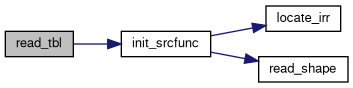
Read a single ASCII emissivity lookup table.
Reads one ASCII table for detector/channel index id and emitter/gas index ig from a file named:
<ctl->tblbase>_<ctl->nu[id]>_<ctl->emitter[ig]>.tab
The table file contains four columns:
The routine infers the pressure/temperature/column-density indices from changes in the values read from the file. Values outside the supported ranges for column density or emissivity are skipped and counted.
If the file cannot be opened, a warning is issued and the table is treated as empty (i.e., tbl->np[id][ig] == 0).
| [in] | ctl | Pointer to control structure specifying filenames and grids. |
| [in,out] | tbl | Pointer to the table structure to be filled. |
| [in] | id | Detector/channel index. |
| [in] | ig | Emitter/gas index. |
ERRMSG() if table dimensions exceed TBLNP / TBLNT / TBLNU.np == -1 such that the first increment yields index 0). On return, tbl->np[id][ig] always represents the number of pressure levels (0 for an empty table).Definition at line 6409 of file jurassic.c.
Read a single compact binary emissivity lookup table.
Reads one binary table for detector/channel index id and emitter/gas index ig from a file named:
<ctl->tblbase>_<ctl->nu[id]>_<ctl->emitter[ig]>.bin
The file contains a length field followed by a packed byte blob created by tbl_pack():
size_t nbytes : number of bytes in the packed blobuint8_t blob[] : packed lookup table dataThe blob is unpacked into tbl using tbl_unpack().
If the file cannot be opened, a warning is issued and the table is treated as empty (i.e., tbl->np[id][ig] == 0).
| [in] | ctl | Pointer to control structure specifying filenames and grids. |
| [in,out] | tbl | Pointer to the table structure to be filled. |
| [in] | id | Detector/channel index. |
| [in] | ig | Emitter/gas index. |
ERRMSG() if the file is malformed or unpacking fails.Definition at line 6532 of file jurassic.c.

Read one packed emissivity lookup table from an open NetCDF file.
Loads a previously stored emissivity lookup table for detector/channel index id and emitter (trace gas) index ig from an already opened NetCDF file. The file is expected to have been created by write_tbl_nc().
The NetCDF variable name is derived from the detector/channel frequency:
tbl_XXXX
where XXXX is ctl->nu[id] formatted to four decimal places.
Each variable is stored as a one-dimensional NC_UBYTE array containing a packed lookup-table byte stream. The data are unpacked into tbl using tbl_unpack().
Missing variables are not fatal: a warning is issued and the corresponding table is left empty (i.e., tbl->np[id][ig] remains zero).
The NetCDF file handle ncid must refer to an open file and is not opened or closed by this function.
| [in] | ctl | Control structure defining emitters, detectors, and detector/channel frequencies. |
| [in,out] | tbl | Table structure that receives the unpacked data. |
| [in] | id | Detector/channel index selecting ctl->nu[id]. |
| [in] | ig | Emitter (trace gas) index selecting ctl->emitter[ig]. |
| [in] | ncid | NetCDF file identifier of an already opened file. |
ERRMSG() if the NetCDF variable exists but cannot be read or unpacked (e.g., corrupted contents).Definition at line 6576 of file jurassic.c.

| double scan_ctl | ( | int | argc, |
| char * | argv[], | ||
| const char * | varname, | ||
| const int | arridx, | ||
| const char * | defvalue, | ||
| char * | value | ||
| ) |
Scan control file or command-line arguments for a configuration variable.
Searches for a named variable in the JURASSIC control file or command-line arguments, returning its value as a double. Optionally stores the value as a string and supports array-style parameters (e.g., EMITTER[0], NU[5]).
| [in] | argc | Number of command-line arguments. |
| [in] | argv | Command-line argument vector. |
| [in] | varname | Name of the control variable to read. |
| [in] | arridx | Array index (use -1 for scalar variables). |
| [in] | defvalue | Default value if variable is not found (can be empty). |
| [out] | value | Optional pointer to a string buffer receiving the value (may be NULL if only numeric output is required). |
double.argv[1]), unless it starts with '-'.VAR (scalar)VAR[index] (explicit array index)VAR[*] (wildcard entry applying to all indices)defvalue is used (if non-empty).ctl_t checks to ensure consistency.Definition at line 6613 of file jurassic.c.
| void set_cov_apr | ( | const ret_t * | ret, |
| const ctl_t * | ctl, | ||
| const atm_t * | atm, | ||
| const int * | iqa, | ||
| const int * | ipa, | ||
| gsl_matrix * | s_a | ||
| ) |
Construct the a priori covariance matrix \(\mathbf{S_a}\) for retrieval parameters.
Builds the full a priori covariance matrix based on specified retrieval error assumptions and correlation lengths defined in the ret_t structure. Each diagonal element represents the variance of an individual state vector element, while off-diagonal terms encode spatial correlations between parameters of the same type.
| [in] | ret | Retrieval configuration and error parameters (ret_t). |
| [in] | ctl | Control structure defining retrieval setup and state vector mapping (ctl_t). |
| [in] | atm | Atmospheric profile structure containing geolocation and altitude information (atm_t). |
| [in] | iqa | Index array linking state vector elements to physical quantities (e.g. pressure, temperature, gas, extinction, etc.). |
| [in] | ipa | Index array linking state vector elements to atmospheric grid points. |
| [out] | s_a | Output a priori covariance matrix \(\mathbf{S_a}\) (gsl_matrix), dimension n×n. |
atm2x) and scales them according to their a priori uncertainties:\[ \rho_{ij} = \exp\left(-\frac{d_{ij}}{L_h} - \frac{|z_i - z_j|}{L_v}\right) \]
where:iqa[i] == iqa[j]) are assumed to share correlation properties.ret_t, differing by parameter type:err_press_cz, err_press_cherr_temp_cz, err_temp_cherr_q_cz[], err_q_ch[]err_k_cz[], err_k_ch[]Definition at line 6681 of file jurassic.c.
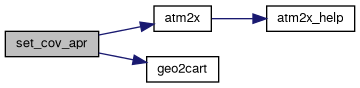
| void set_cov_meas | ( | const ret_t * | ret, |
| const ctl_t * | ctl, | ||
| const obs_t * | obs, | ||
| gsl_vector * | sig_noise, | ||
| gsl_vector * | sig_formod, | ||
| gsl_vector * | sig_eps_inv | ||
| ) |
Construct measurement error standard deviations and their inverse.
Builds the total measurement uncertainty vector used in the optimal estimation retrieval, accounting for both instrument noise and forward model (systematic) errors.
| [in] | ret | Retrieval configuration and error parameters (ret_t). |
| [in] | ctl | Control structure defining spectral channels and setup (ctl_t). |
| [in] | obs | Observation dataset (obs_t), containing measured radiances or brightness temperatures. |
| [out] | sig_noise | Vector of instrument noise standard deviations (gsl_vector), length m. |
| [out] | sig_formod | Vector of forward model error standard deviations (gsl_vector), length m. |
| [out] | sig_eps_inv | Vector of inverse total standard deviations, \(\sigma_\epsilon^{-1}\), used for normalization. |
\[ \sigma_{\epsilon,i}^2 = \sigma_{\text{noise},i}^2 + \sigma_{\text{formod},i}^2 \]
and stores its reciprocal square root:\[ (\sigma_{\epsilon,i}^{-1}) = \frac{1}{\sqrt{\sigma_{\epsilon,i}^2}} \]
sig_noise)** ret->err_noise[id] for each spectral channel. The noise term is always included in the fit.sig_formod)** ret->err_formod[id]) of the measured radiance (or brightness temperature) per channel. This represents uncertainty due to imperfect forward modeling.sig_eps_inv) is used to normalize the measurement residuals \((y - F(x))\) in the cost function.NAN.obs and ctl are consistent in dimension and indexing.Definition at line 6792 of file jurassic.c.
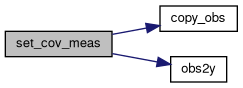
| const char * shared_io_input_target | ( | const ret_t * | ret, |
| const char * | shared_file, | ||
| const char * | legacy_file, | ||
| const char ** | dirname, | ||
| int * | profile | ||
| ) |
Resolve retrieval input target for legacy-directory and shared-file modes.
Chooses whether a retrieval input should be read from the legacy per-directory file layout or from a shared netCDF file selected through the retrieval control structure.
| [in] | ret | Retrieval configuration structure (ret_t). |
| [in] | shared_file | Shared input file name from ret_t; ignored when set to "-". |
| [in] | legacy_file | Legacy per-directory input file name. |
| [out] | dirname | Output directory pointer. Set to ret->dir for legacy input and to NULL for shared-file input. |
| [out] | profile | Record index used by the generic I/O wrappers. |
shared_file, sets *dirname = NULL, and uses ret->shared_io_profile as the profile or dataset index.legacy_file, sets *dirname = ret->dir, and resets *profile = 0.Definition at line 6841 of file jurassic.c.
| const char * shared_io_output_target | ( | const ret_t * | ret, |
| const char * | shared_file, | ||
| const char * | legacy_file, | ||
| const char ** | dirname, | ||
| int * | profile | ||
| ) |
Resolve retrieval output target for legacy-directory and shared-file modes.
Chooses whether a retrieval product should be written into the legacy per-directory file layout or into a shared netCDF file selected through the retrieval control structure.
| [in] | ret | Retrieval configuration structure (ret_t). |
| [in] | shared_file | Shared output file name from ret_t; ignored when set to "-". |
| [in] | legacy_file | Legacy per-directory output file name. |
| [out] | dirname | Output directory pointer. Set to ret->dir for legacy output and to NULL for shared-file output. |
| [out] | profile | Record index used by the generic I/O wrappers. |
shared_file, sets *dirname = NULL, and uses ret->shared_io_profile as the profile or dataset index.legacy_file, sets *dirname = ret->dir, and resets *profile = 0.Definition at line 6861 of file jurassic.c.
| int shared_io_lock | ( | const ret_t * | ret | ) |
Acquire an exclusive lock for shared retrieval output files.
Creates or opens a lock file derived from the configured shared retrieval output target and blocks until an exclusive file lock can be obtained.
| [in] | ret | Retrieval configuration structure (ret_t). |
-1 if no shared output file is configured.The lock file name is formed as "<shared-output>.lock", where shared-output is determined by shared_io_output_file(). The lock is used to serialize writes when multiple retrieval processes or MPI ranks write into the same shared netCDF files.
Definition at line 6881 of file jurassic.c.

| void shared_io_unlock | ( | int | fd | ) |
Release a shared retrieval output lock.
Unlocks and closes the file descriptor returned by shared_io_lock().
| [in] | fd | Lock file descriptor returned by shared_io_lock(). |
Passing a negative descriptor is allowed and results in no action.
Definition at line 6908 of file jurassic.c.
| const char * shared_io_output_file | ( | const ret_t * | ret | ) |
Return the primary shared retrieval output file configured for locking.
Scans the shared retrieval output file fields in ret_t and returns the first configured file name. This file name is then used as the base for the shared lock file created by shared_io_lock().
| [in] | ret | Retrieval configuration structure (ret_t). |
NULL if shared-output mode is not active.Definition at line 6926 of file jurassic.c.
| void tangent_point | ( | const los_t * | los, |
| double * | tpz, | ||
| double * | tplon, | ||
| double * | tplat | ||
| ) |
Determine the tangent point along a line of sight (LOS).
Computes the location of the tangent point — the point of minimum altitude — along the current line of sight, based on the LOS geometry stored in los_t.
| [in] | los | Pointer to the line-of-sight (LOS) structure containing altitude, longitude, latitude, and segment length data. |
| [out] | tpz | Pointer to variable receiving tangent point altitude [km]. |
| [out] | tplon | Pointer to variable receiving tangent point longitude [deg]. |
| [out] | tplat | Pointer to variable receiving tangent point latitude [deg]. |
ds) must be consistent with the geometric spacing between altitude points for the interpolation to be accurate.Definition at line 6960 of file jurassic.c.
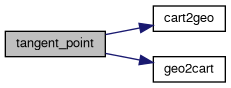
Free lookup table and all internally allocated memory.
Frees all dynamically allocated memory owned by a tbl_t object, including the spectral lookup arrays (logu and logeps) for all detector/emitter/pressure/temperature combinations. The tbl_t structure itself is freed at the end.
The function is safe to call with a NULL pointer and will return immediately in that case. Partially initialized tables are handled safely.
| [in,out] | tbl | Pointer to the lookup table to be freed. |
| [in] | ctl | Control structure providing the number of detectors and emitters used for looping. |
free(tbl) since tbl_t contains nested dynamically allocated members.Definition at line 7003 of file jurassic.c.
| void tbl_pack | ( | const tbl_t * | tbl, |
| int | id, | ||
| int | ig, | ||
| uint8_t * | buf, | ||
| size_t * | bytes_used | ||
| ) |
Pack a lookup table into a contiguous binary buffer.
This function serializes the lookup table data for a given detector (id) and emitter (ig) into a compact, platform-native binary representation. The packed data can be written to disk (e.g., in a NetCDF variable) and later reconstructed using tbl_unpack().
The packed layout in buf is, in order:
int np : number of pressure grid pointsdouble p[np] : pressure gridip:int nt : number of temperature grid pointsdouble t[nt] : temperature gridit:int nu : number of spectral grid pointsfloat u[nu] : spectral valuesfloat eps[nu] : associated epsilon valuesNo byte-order conversion or padding is applied; the data are written exactly as laid out in memory.
| [in] | tbl | Table structure containing the lookup data. |
| [in] | id | Detector index. |
| [in] | ig | Emitter index. |
| [out] | buf | Destination buffer that will receive the packed binary data. |
| [out] | bytes_used | Number of bytes written to buf. |
buf is large enough to hold the packed data for the selected detector/emitter pair. The packed representation includes the detector filter function (mandatory for binary/netCDF formats). No bounds checking is performed inside this function.Definition at line 7042 of file jurassic.c.
| size_t tbl_packed_size | ( | const tbl_t * | tbl, |
| int | id, | ||
| int | ig | ||
| ) |
Compute required buffer size (in bytes) for tbl_pack().
Returns the exact number of bytes that tbl_pack() will write for the given detector/emitter pair (including the mandatory filter function).
Definition at line 7096 of file jurassic.c.
| size_t tbl_unpack | ( | tbl_t * | tbl, |
| int | id, | ||
| int | ig, | ||
| const uint8_t * | buf | ||
| ) |
Unpack a lookup table from a contiguous binary buffer.
This function reconstructs the lookup table data for a given detector (id) and emitter (ig) from a binary buffer previously produced by tbl_pack(). The packed data are read sequentially and copied into the corresponding fields of the tbl structure.
The expected layout of buf is:
int npdouble p[np]ip:int ntdouble t[nt]it:int nufloat u[nu]float eps[nu]Range checks are applied to np, nt, and nu against the compile-time limits TBLNP, TBLNT, and TBLNU to prevent buffer overruns and invalid table sizes.
| [in,out] | tbl | Table structure that will receive the unpacked data. |
| [in] | id | Detector index. |
| [in] | ig | Emitter index. |
| [in] | buf | Source buffer containing the packed binary table. |
buf.tbl_pack(). Supplying malformed or truncated data will result in undefined behavior or an error.Definition at line 7130 of file jurassic.c.
| void time2jsec | ( | const int | year, |
| const int | mon, | ||
| const int | day, | ||
| const int | hour, | ||
| const int | min, | ||
| const int | sec, | ||
| const double | remain, | ||
| double * | jsec | ||
| ) |
Converts time components to seconds since January 1, 2000, 12:00:00 UTC.
This function calculates the number of seconds elapsed since January 1, 2000, 12:00:00 UTC, based on the provided year, month, day, hour, minute, and second. It also includes a fractional part to represent the remaining seconds.
| year | The year. |
| mon | The month (1-12). |
| day | The day of the month (1-31). |
| hour | The hour of the day (0-23). |
| min | The minute (0-59). |
| sec | The second (0-59). |
| remain | The fractional part of seconds. |
| jsec | Pointer to store the calculated number of seconds since January 1, 2000, 12:00:00 UTC. |
The function calculates the time elapsed since January 1, 2000, 12:00:00 UTC, up to the specified time and includes any fractional seconds indicated by the "remain" parameter.
Definition at line 7206 of file jurassic.c.
| void timer_group | ( | const char * | name, |
| const char * | group, | ||
| int | output | ||
| ) |
Aggregate wall-clock timings for named code phases.
Tracks elapsed time for the currently active timer and accumulates it both per timer name and per timer group. Calling the function with output set to a non-zero value prints the current timing summary including total time, minimum, mean, standard deviation, maximum, and sample count for each timer.
| [in] | name | Name of the next timer to activate. |
| [in] | group | Group name of the next timer to activate. |
| [in] | output | If non-zero, print the accumulated timing summary. |
Definition at line 7237 of file jurassic.c.
| void write_atm | ( | const char * | dirname, |
| const char * | filename, | ||
| const ctl_t * | ctl, | ||
| const atm_t * | atm, | ||
| int | profile | ||
| ) |
Write atmospheric data to a file.
This function writes the atmospheric dataset stored in atm to the file specified by filename, optionally prefixed by dirname. The output format (ASCII or binary) is selected based on the atmospheric format flag ctl->atmfmt. The function creates the output file, delegates the writing process to the appropriate format-specific routine, and logs summary statistics of the written atmospheric data.
Supported output formats:
ctl->atmfmt == 1), written by write_atm_asc()ctl->atmfmt == 2), written by write_atm_bin()The function writes:
ctl->ng)ctl->nw)ctlAfter writing, the function logs minimum and maximum values of the written fields for verification and diagnostic purposes.
| dirname | Optional directory in which the output file will be created. If NULL, only filename is used. |
| filename | Name of the output file to be created and populated with atmospheric data. |
| ctl | Pointer to a control structure defining the output format and the sizes of gas, spectral, cloud, and surface parameter arrays. |
| atm | Pointer to the atmospheric data structure whose contents will be written. All required fields must be initialized and contain atm->np valid data points. |
| profile | Zero-based profile index for netCDF output. Ignored for ASCII and binary formats. |
ERRMSG if the file cannot be created or if an unsupported output format is requested.Definition at line 7308 of file jurassic.c.
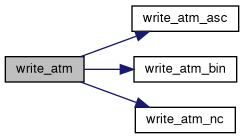
Write atmospheric data to an ASCII file.
This function writes the contents of an atmospheric structure atm to an ASCII file specified by its filename. A descriptive column header is written first, documenting the meaning, units, and ordering of each data field. Atmospheric data points are then written line by line, with optional cloud and surface layer parameters appended if they are enabled in the control structure ctl.
The output columns include, in order:
ctl->ng) [ppv]ctl->nw) [km^-1]If cloud layer properties are enabled (ctl->ncl > 0), the following are added:
ctl->ncl) [km^-1]If surface layer properties are enabled (ctl->nsf > 0), the following are added:
ctl->nsf)| filename | Path to the ASCII output file. |
| ctl | Pointer to a control structure defining the number of gases, spectral windows, and whether cloud or surface layer information should be included. |
| atm | Pointer to the atmospheric structure containing the data to be written. The function writes all atm->np data points. |
atm are properly allocated and populated. No validation of data ranges is performed here.Definition at line 7379 of file jurassic.c.
Write atmospheric data to a binary file.
This function writes the atmospheric dataset contained in atm to a binary file specified by its filename. The output format is compact and includes a file header followed by the serialized atmospheric fields. The format is compatible with read_atm_bin(), ensuring that files written by this function can be read back without loss of information.
The binary file structure written is as follows:
"ATM1" (4 bytes)ctl->ng)ctl->nw)ctl->ncl)ctl->nsf)np np containing:ctl->ng × np)ctl->nw × np)ctl: ctl->ncl)ctl->nsf)| filename | Path to the binary output file. |
| ctl | Pointer to a control structure specifying the number of gases, spectral windows, and whether cloud or surface layer parameters must be included. |
| atm | Pointer to the atmospheric data structure containing values to be written. All arrays must be populated and atm->np must contain the number of valid atmospheric records. |
atm contents. It assumes that the memory layout matches expectations.read_atm_bin(); modifying either implementation requires updating the other accordingly.Definition at line 7446 of file jurassic.c.
Write one atmospheric profile to a netCDF file.
This routine writes a single profile from an atm_t structure into a netCDF file using an unlimited record dimension. Multiple profiles can be stored in the same file by calling this function repeatedly with increasing profile indices, provided they fit the file's fixed level dimension.
The function creates the file if it does not exist (netCDF-4/HDF5) and defines missing dimensions/variables on the fly. Existing definitions are reused.
Dimensions:
profile : unlimited (record dimension)level : fixed (maximum number of vertical levels stored in the file)Variables:
nlev(profile) : number of valid levels for each profile (written as atm->np)time,z,lon,lat,p,t(profile,level)ctl->emitter[ig] with dimensions ext_win_d(profile,level)ctl->ncl>0): cld_z, cld_dz, cld_k_%.4f(profile)ctl->nsf>0): srf_t, srf_eps_%.4f(profile)Only the first atm->np elements along level are written for 2-D variables. The effective number of levels is stored in nlev(profile). The file uses one shared fixed level dimension for all profiles, so any later profile must satisfy atm->np <= level. (If a profile is overwritten with fewer levels than previously written, old values above nlev may remain unless explicitly filled by the caller.)
| filename | Output netCDF file name. |
| ctl | Control structure (defines numbers/names of optional fields, e.g., ng, nw, ncl, nsf, and emitter[]). |
| atm | Atmospheric profile data to write (uses atm->np levels). |
| profile | Record index along the unlimited profile dimension. |
HAVE_NETCDF) and uses the netCDF C API. Errors are handled via the NC(...) macro.Definition at line 7530 of file jurassic.c.
Write atmospheric profile in RFM-compatible format.
Exports the current atmospheric state to a file formatted for use with the Reference Forward Model (RFM). The file includes altitude, pressure, temperature, and volume mixing ratio profiles for each active emitter.
| [in] | filename | Output file name for the RFM atmosphere file. |
| [in] | ctl | Pointer to the control structure defining active emitters. |
| [in] | atm | Pointer to the atmospheric profile to export. |
atm->np).*HGT, *PRE, etc.) and lists one value per line.Definition at line 7717 of file jurassic.c.
| void write_matrix | ( | const char * | dirname, |
| const char * | filename, | ||
| const ctl_t * | ctl, | ||
| const gsl_matrix * | matrix, | ||
| const atm_t * | atm, | ||
| const obs_t * | obs, | ||
| const char * | rowspace, | ||
| const char * | colspace, | ||
| const char * | sort, | ||
| int | dataset | ||
| ) |
Write a fully annotated matrix (e.g., Jacobian or gain matrix) to file.
Dispatches matrix output according to the configured matrix file format. Supported formats are ASCII (MATRIXFMT=1), binary (MATRIXFMT=2), and netCDF (MATRIXFMT=3).
| [in] | dirname | Output directory path. If NULL, only filename is used. |
| [in] | filename | Output matrix file name. |
| [in] | ctl | Control structure defining output format and metadata interpretation. |
| [in] | matrix | Matrix to be written. |
| [in] | atm | Atmospheric reference state used for state-space metadata. |
| [in] | obs | Observation reference state used for measurement-space metadata. |
| [in] | rowspace | Row-space selector passed to the backend writer. |
| [in] | colspace | Column-space selector passed to the backend writer. |
| [in] | sort | Sort-order selector passed to the backend writer. |
| [in] | dataset | Zero-based dataset index for netCDF output. Ignored for ASCII and binary formats. |
Definition at line 7754 of file jurassic.c.
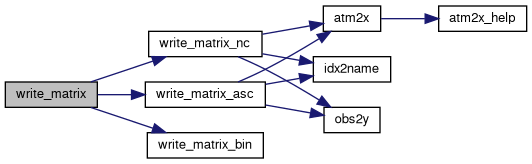
| void write_matrix_asc | ( | const char * | dirname, |
| const char * | filename, | ||
| const ctl_t * | ctl, | ||
| const gsl_matrix * | matrix, | ||
| const atm_t * | atm, | ||
| const obs_t * | obs, | ||
| const char * | rowspace, | ||
| const char * | colspace, | ||
| const char * | sort | ||
| ) |
Write a fully annotated matrix (e.g., Jacobian or gain matrix) to an ASCII file.
Outputs a numerical matrix along with detailed metadata describing the row and column spaces. Depending on configuration, the rows and columns may correspond to measurement or state variables.
| [in] | dirname | Output directory path (may be NULL). |
| [in] | filename | Output file name. |
| [in] | ctl | Pointer to control structure defining model setup and metadata. |
| [in] | matrix | Pointer to GSL matrix to write (e.g., Jacobian, kernel, or covariance). |
| [in] | atm | Pointer to atmospheric data structure (used when state-space indexing applies). |
| [in] | obs | Pointer to observation data structure (used when measurement-space indexing applies). |
| [in] | rowspace | Selects row labeling: "y" = measurement space, otherwise state space. |
| [in] | colspace | Selects column labeling: "y" = measurement space, otherwise state space. |
| [in] | sort | Determines writing order: "r" = row-major, otherwise column-major. |
ctl->write_matrix — output is skipped if disabled.sort to support row-major or column-major output.Definition at line 7791 of file jurassic.c.
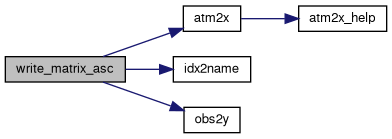
| void write_matrix_bin | ( | const char * | dirname, |
| const char * | filename, | ||
| const gsl_matrix * | matrix | ||
| ) |
Write a numerical matrix to a binary file.
Stores a compact binary representation consisting of a magic identifier, matrix dimensions, and all matrix elements in row-major order. Unlike the ASCII format, this binary format does not include annotated row/column metadata.
| [in] | dirname | Output directory path (may be NULL). |
| [in] | filename | Output file name. |
| [in] | matrix | Pointer to GSL matrix to write. |
Definition at line 7964 of file jurassic.c.
| void write_matrix_nc | ( | const char * | dirname, |
| const char * | filename, | ||
| const ctl_t * | ctl, | ||
| const gsl_matrix * | matrix, | ||
| const atm_t * | atm, | ||
| const obs_t * | obs, | ||
| const char * | rowspace, | ||
| const char * | colspace, | ||
| const char * | sort, | ||
| int | dataset | ||
| ) |
Write a numerical matrix to a netCDF file.
Stores one matrix record in a netCDF file using an unlimited dimension dataset, fixed dimensions row and col, and a variable matrix(dataset,row,col). The file also records the row space, column space, and sort order in per-dataset auxiliary variables. Per-row and per-column metadata are stored in auxiliary variables row_nu, row_time, row_z, row_lon, row_lat, row_quantity, col_nu, col_time, col_z, col_lon, col_lat, and col_quantity. Quantity-name strings use the fixed netCDF dimension name_strlen = 100.
| [in] | dirname | Output directory path (may be NULL). |
| [in] | filename | Output file name. |
| [in] | ctl | Pointer to control structure. |
| [in] | matrix | Pointer to GSL matrix to write. |
| [in] | atm | Pointer to atmospheric data structure. |
| [in] | obs | Pointer to observation data structure. |
| [in] | rowspace | Row-space selector to store as metadata. |
| [in] | colspace | Column-space selector to store as metadata. |
| [in] | sort | Sort-order selector to store as metadata. |
| [in] | dataset | Zero-based index along the unlimited dataset dimension. |
Definition at line 8013 of file jurassic.c.
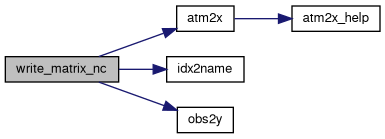
| void write_obs | ( | const char * | dirname, |
| const char * | filename, | ||
| const ctl_t * | ctl, | ||
| const obs_t * | obs, | ||
| int | profile | ||
| ) |
Write observation data to an output file in ASCII or binary format.
This C function constructs the full output file path from the provided directory and filename, opens the file for writing, and exports the contents of the obs_t structure in either ASCII or binary format, depending on the observation format specified by ctl->obsfmt. The actual writing of formatted data is delegated to write_obs_asc() or write_obs_bin().
After writing, the function prints diagnostic information showing ranges of times, observer coordinates, view point coordinates, tangent point coordinates, and spectral values stored as radiance or brightness temperature depending on ctl->write_bbt, as well as transmittances. These diagnostics provide useful verification that the output data is valid and consistent.
| [in] | dirname | Optional directory path. If NULL, only filename is used. |
| [in] | filename | Name of the output observation file. |
| [in] | ctl | Control structure specifying output format, spectral channel configuration, and brightness-temperature mode. |
| [in] | obs | Observation structure containing the data to be written. |
| [in] | profile | Zero-based profile index for netCDF output. Ignored for ASCII and binary formats. |
ctl->obsfmt specifies an unsupported format.Definition at line 8276 of file jurassic.c.
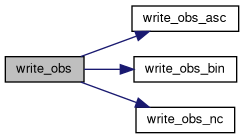
Write observation data to an ASCII text file.
This C function writes the contents of the obs_t observation structure as human-readable ASCII text to a file specified by its filename. It first prints a descriptive header that documents each column of the output format, including observation time, observer and view geometry, tangent point information, and spectral values. The number and meaning of spectral fields depend on ctl->nd and whether brightness temperature output is enabled via ctl->write_bbt.
The function then writes one line of data per ray path, including the base geometric information followed by spectral values labeled as radiance or brightness temperature according to ctl->write_bbt, and transmittances for each spectral channel. Blank lines are inserted whenever the time stamp changes, providing visual separation of distinct observation groups.
| filename | Path to the ASCII output file. |
| ctl | Control structure specifying the number of spectral channels (nd), wavenumbers (nu), and output mode (write_bbt). |
| obs | Observation structure containing the data to be written. |
filename is writable. Existing files may be overwritten.Definition at line 8347 of file jurassic.c.
Write observation data in binary format to a file.
This C function serializes the contents of the obs_t structure into a compact binary format and writes it to a file specified by its filename. The binary format begins with a header consisting of a magic identifier ("OBS1") and the number of spectral channels (ctl->nd). This header is used by read_obs_bin() to validate compatibility when reading.
Following the header, the function writes the number of ray paths and then sequentially outputs arrays of observation metadata, geometric parameters, spectral values stored as radiance or brightness temperature depending on ctl->write_bbt, and transmittances. All values are written in native binary representation using the FWRITE() macro, which performs buffered writes and error checking.
| filename | Path to the binary output file. |
| ctl | Control structure specifying the number of spectral channels (nd) and corresponding configuration parameters. |
| obs | Observation structure containing the data to be written. |
filename is writable. Existing files may be overwritten.Definition at line 8403 of file jurassic.c.
| void write_obs_nc | ( | const char * | filename, |
| const ctl_t * | ctl, | ||
| const obs_t * | obs, | ||
| const int | profile | ||
| ) |
Write one observation profile to a NetCDF file.
This function writes all geometric and spectral observation data for a single profile into a NetCDF file using a variable-per-channel layout. If the file does not exist it is created; if it already exists, the required dimensions and variables are created if missing and then extended by writing the specified profile.
The NetCDF file will contain:
profile (unlimited)ray (fixed, number of ray paths)nray(profile) giving the number of rays for each profiletime, obs_z, obs_lon, obs_lat vp_z, vp_lon, vp_lat tp_z, tp_lon, tp_lat rad_%.4f (radiance, if ctl->write_bbt == 0)bt_%.4f (brightness temperature, if ctl->write_bbt != 0)tau_%.4f (transmittance) where the formatted frequency corresponds to ctl->nu[id].Spectral data are written as physical radiance in rad_%.4f variables when ctl->write_bbt == 0, or as brightness temperature in bt_%.4f variables when ctl->write_bbt != 0. The ray dimension is fixed on first creation and all subsequently written profiles must not exceed this number of rays.
| filename | Path to the NetCDF observation file. |
| ctl | Pointer to the control structure defining spectral channels. |
| obs | Pointer to the observation structure containing the data to be written. |
| profile | Zero-based index of the profile to write. |
Definition at line 8471 of file jurassic.c.
| void write_shape | ( | const char * | filename, |
| const double * | x, | ||
| const double * | y, | ||
| const int | n | ||
| ) |
Write tabulated shape function data to a text file.
Exports a shape function (typically a weighting or field-of-view profile) defined by paired arrays of x and y values to an ASCII file.
| [in] | filename | Output file name. |
| [in] | x | Pointer to array of x-values (independent variable). |
| [in] | y | Pointer to array of y-values (dependent variable). |
| [in] | n | Number of data points to write. |
read_shape() for re-import.Definition at line 8651 of file jurassic.c.
| void write_stddev | ( | const char * | quantity, |
| const ret_t * | ret, | ||
| const ctl_t * | ctl, | ||
| const atm_t * | atm, | ||
| const gsl_matrix * | s | ||
| ) |
Write retrieval standard deviation profiles to disk.
Extracts the diagonal elements of a covariance matrix (a priori, posterior, or error covariance) to obtain the standard deviations of retrieved quantities and writes them as an atmospheric profile file.
| [in] | quantity | Name of the retrieved quantity (e.g., "apr", "pos", "err"), used to label the output file. |
| [in] | ret | Retrieval configuration structure (ret_t), providing the working directory for output files. |
| [in] | ctl | Global control structure (ctl_t) defining retrieval setup and quantities. |
| [in] | atm | Reference atmospheric state (atm_t) for spatial/geometric metadata. |
| [in] | s | Covariance matrix (gsl_matrix, n×n) from which standard deviations are derived (typically posterior covariance \(\mathbf{S}\)). |
This function performs the following operations:
atm) into an auxiliary structure (atm_aux) to preserve coordinate and geometric metadata.x2atm(), thereby mapping elements of the state vector to the corresponding atmospheric quantities.\[ \texttt{<ret->dir>/atm\_err\_<quantity>.tab} \]
using the standard JURASSIC atmospheric file format.atm_err_<quantity>.tab (e.g., atm_err_apr.tab, atm_err_pos.tab).ctl.s must be symmetric and positive-definite.x2atm) must correspond to the matrix ordering.Definition at line 8680 of file jurassic.c.
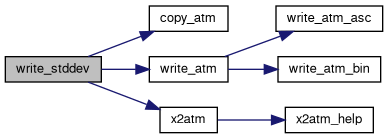
Write emissivity lookup tables to disk.
Writes emissivity lookup tables stored in tbl using the output format specified by ctl->tblfmt:
ctl->tblfmt == 1)ctl->tblfmt == 2)ctl->tblfmt == 3)The function iterates over all emitters (ig) and detectors/channels (id) and dispatches the corresponding per-table writer.
Lookup tables with no pressure levels (i.e. tbl->np[id][ig] <= 0) are skipped intentionally. In this case, a warning is issued and no output artifact (file or NetCDF variable) is written for the affected table. This allows trace gases or channels with negligible contribution to be omitted cleanly from the output.
After writing the lookup tables, the associated spectral filter functions are written to separate files (format-dependent).
| [in] | ctl | Pointer to the control structure defining the lookup table output format, base filenames, emitters, and spectral channels. |
| [in] | tbl | Pointer to the lookup-table structure containing the emissivity data and filter functions to be written. |
ctl->tblfmt, the function aborts with an error message.Definition at line 8723 of file jurassic.c.
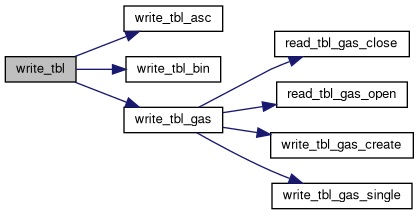
Write one emissivity lookup table in human-readable ASCII format.
Writes the lookup table for detector/channel index id and emitter/gas index ig to a file named:
<ctl->tblbase>_<ctl->nu[id]>_<ctl->emitter[ig]>.tab
The ASCII file contains four columns:
A header describing the columns is always written. If the table is empty (i.e. tbl->np[id][ig] == 0), the file will contain only the header.
| [in] | ctl | Control structure providing filename base, frequencies, and emitter names. |
| [in] | tbl | Lookup table data to be written. |
| [in] | id | Detector/channel index. |
| [in] | ig | Emitter/gas index. |
Definition at line 8766 of file jurassic.c.
Write one emissivity lookup table in compact binary format.
Writes the lookup table for detector/channel index id and emitter/gas index ig to a file named:
<ctl->tblbase>_<ctl->nu[id]>_<ctl->emitter[ig]>.bin
The file contains a length field followed by a packed byte blob produced by tbl_pack():
size_t nbytes : number of bytes in the packed blobuint8_t blob[] : packed lookup table data (see tbl_pack())If the table is empty (tbl->np[id][ig] == 0), the packed blob still encodes this (it includes np = 0), so the file remains a valid representation of an empty table.
| [in] | ctl | Control structure providing filename base, frequencies, and emitter names. |
| [in] | tbl | Lookup table data to be packed and written. |
| [in] | id | Detector/channel index. |
| [in] | ig | Emitter/gas index. |
Definition at line 8808 of file jurassic.c.
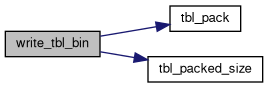
Write one packed lookup table to a NetCDF file.
Writes the lookup table for detector/channel index id and emitter/gas index ig to the NetCDF file:
<ctl->tblbase>_<ctl->emitter[ig]>.nc
The table is stored as a packed byte blob (produced by tbl_pack()) in a variable named tbl_XXXX with a corresponding dimension len_XXXX, where XXXX is the formatted frequency ctl->nu[id]. The variable type is NC_UBYTE.
If the NetCDF file does not exist, it is created and initialized with the global attributes:
format_version = "1"emitter = ctl->emitter[ig]To prevent accidental overwrites, the function terminates with an error if the target variable already exists in the file.
| [in] | ctl | Control structure defining emitter names, frequencies, and base filename. |
| [in] | tbl | Lookup table data structure containing the lookup table to be packed and written. |
| [in] | id | Detector/channel index. |
| [in] | ig | Emitter/gas index. |
Definition at line 8850 of file jurassic.c.
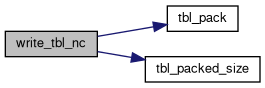
Map retrieval state vector back to atmospheric structure.
Updates the atmospheric data structure (atm_t) from the contents of a retrieval state vector (x). This function performs the inverse transformation of atm2x(), assigning retrieved quantities such as pressure, temperature, gas volume mixing ratios, extinction, and cloud/surface parameters to the corresponding atmospheric fields.
| [in] | ctl | Pointer to control structure defining retrieval settings, vertical range limits, and active retrieval flags. |
| [in] | x | Pointer to retrieval state vector containing the updated values. |
| [out] | atm | Pointer to atmospheric data structure to be updated. |
ctl->ret*_zmin/ctl->ret*_zmax).x2atm_help() is called to sequentially read the next element from the state vector.atm2x() to ensure one-to-one correspondence between state vector indices and atmospheric fields.Quantities mapped:
p[zmin:zmax])t[zmin:zmax])q[ig][zmin:zmax])k[iw][zmin:zmax])clz, cldz, clk)sft, sfeps)ctl (e.g. ret_sft, ret_clk) are modified.n) advances automatically as each element is read.x2atm_help() abstracts sequential access to vector elements.Definition at line 8915 of file jurassic.c.

| void x2atm_help | ( | double * | value, |
| const gsl_vector * | x, | ||
| size_t * | n | ||
| ) |
Helper function to extract a single value from the retrieval state vector.
Retrieves the next element from the state vector x and assigns it to the provided scalar variable. This function is used by x2atm() to sequentially map the contents of the retrieval vector into the corresponding fields of the atmospheric structure.
| [out] | value | Pointer to the scalar variable to be updated. |
| [in] | x | Pointer to the retrieval state vector (gsl_vector). |
| [in,out] | n | Pointer to the current index in the state vector. The index is incremented after each extraction. |
atm2x() and x2atm().*n after reading a value, maintaining the correct position in the vector for subsequent calls.Definition at line 8965 of file jurassic.c.
Copy elements from the measurement vector y into the observation structure.
Decomposes the 1-D measurement vector y into its radiance components and writes them into the 2-D observation array obs->rad[id][ir], using the same ordering as produced by the corresponding forward model.
Only entries for which obs->rad[id][ir] is finite are updated. This allows missing or masked radiances to remain untouched in the observation structure.
| [in] | ctl | Control settings defining the number of detector channels (ctl->nd) and other retrieval configuration parameters. |
| [in] | y | Measurement vector containing radiances in forward-model order. |
| [out] | obs | Observation structure whose radiance array (obs->rad) is to be filled with values from y. |
The function loops over all ray paths (obs->nr) and detector channels (ctl->nd). For each pair (detector id, ray ir) where an existing value in obs->rad[id][ir] is finite, the next element from the measurement vector y is inserted. The counter m tracks progression through y.
This function is the inverse operation of the packing performed when constructing the measurement vector from an obs_t structure.
y must contain as many finite elements as the number of finite entries in obs->rad, in the same scanning order.Definition at line 8977 of file jurassic.c.
 1.9.4
1.9.4